
LONGQIAO Technical Team | Product & Applications | Published September 2, 2026
A linear shaft rod is a round, heat-treated shaft that guides motion in combination with a sliding or rolling bearing block, either mounted unsupported at both ends or backed along its length by a supported rail such as SBR or TBR. Which one you need depends on how much the shaft deflects across its span under load — not on price alone.
LONGQIAO’s linear shaft rod is manufactured to a controlled diameter and surface finish, then heat-treated for durability, and it’s designed to be paired with a sliding bearing — a plain bushing riding directly on the shaft’s ground surface rather than a rolling-element block. That pairing is what makes it the simplest and generally most economical way to constrain motion to one axis: no profile rail, no ball recirculation path, just a round shaft and a bushing.
The catch is in how a round shaft behaves once you mount it. Supported only at its two end blocks, a shaft is essentially a beam — and beams sag in the middle as the unsupported distance between their supports grows. That sag is deflection, and it’s the variable that decides everything else in this article.
Deflection under a given load doesn’t grow in a straight line with span length — it grows much faster than that, which is why a shaft that performs fine at a short span can sag noticeably once you stretch the same design across a longer one. This is basic beam mechanics, true of any round shaft regardless of who manufactures it: the longer the unsupported distance between mounting points, the more the middle of the shaft deflects under the same load, and the relationship accelerates rather than scaling evenly.
This is why “just use a bigger diameter shaft” isn’t a complete answer to a long-span problem. A larger diameter does stiffen the shaft, but past a certain span, you’re fighting a curve that outpaces what diameter alone can economically correct — and that’s the point where a supported rail, which carries the shaft’s weight continuously along its length rather than just at the ends, becomes the right tool rather than an upgrade for its own sake.
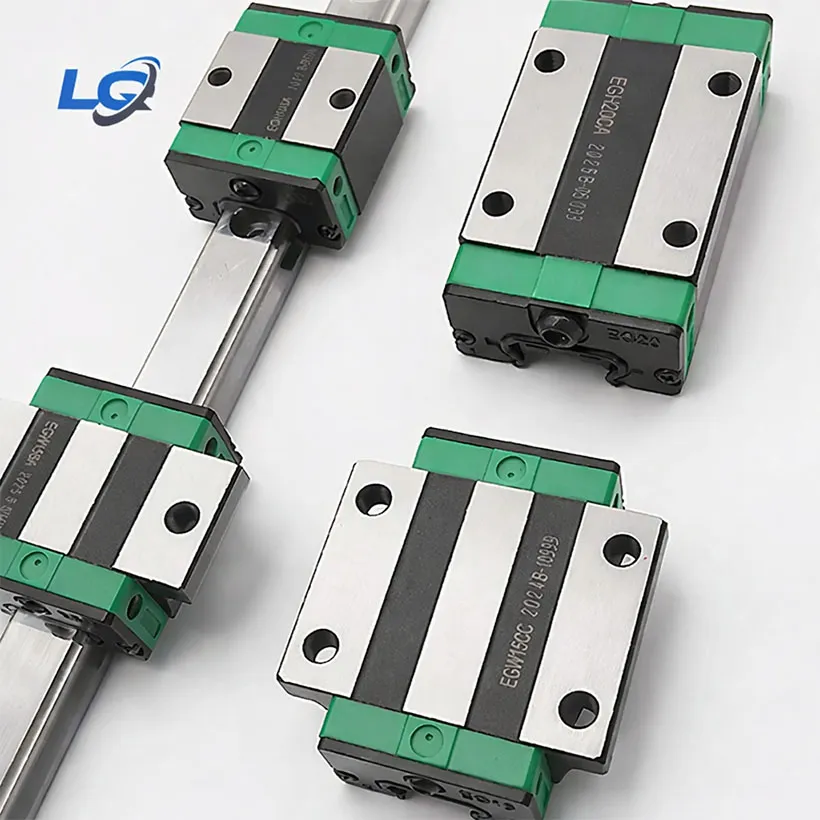
Unsupported linear shaft rod is the right choice when the span between mounting points is short relative to the shaft’s diameter and the load doesn’t push deflection past what the application can tolerate. Typical fits:
Where this goes wrong: extending a short-span design to a longer axis without re-checking deflection, because “it worked fine on the last machine” doesn’t account for the span having grown.
Once span length, load, or accuracy requirement pushes past what unsupported shaft comfortably handles, the choice moves to a supported configuration — and LONGQIAO offers two, built around different priorities:
SBR (Support Rail) is the load-capacity answer. It gives a long-span, long-stroke, heavy-duty axis higher rigidity than an unsupported shaft of the same diameter, while staying the more economical and easier-to-install option between the two supported types. Choose SBR when the driving concern is carrying real load across a real distance without excessive sag, and dimensional accuracy requirements are reasonable rather than tight.
TBR (Support Rail) is the accuracy answer. It’s built specifically to deliver higher running stability and positioning accuracy than an unsupported shaft configuration, making it the pick when the axis needs to hold a tighter tolerance across its travel — not just avoid excessive sag, but actually track a precise, repeatable line.
The practical way to separate them: if the question is “will this sag under load,” you’re likely looking at SBR; if the question is “will this stay accurate enough for the job,” TBR is worth the added consideration.
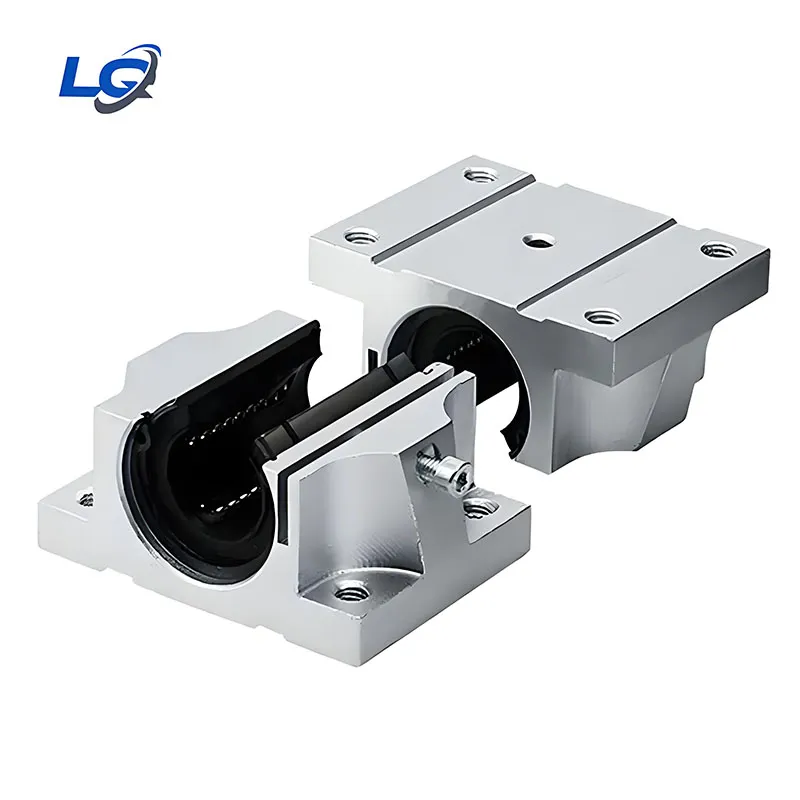
The most frequent misstep in this decision isn’t picking unsupported shaft when it should’ve been supported rail — it’s assuming a bigger-diameter shaft solves a sag problem on its own while the actual weak point is soft or under-braced end mounting. A shaft can be sized correctly for its span and still show deflection if the brackets holding its ends aren’t rigid enough to actually act as a fixed support. Diameter addresses the shaft; it does nothing for a mounting bracket that flexes under the same load.
| Configuration | Support Along Span | Best Fit | Relative Cost Position | Positioning Accuracy |
| Linear Shaft Rod (unsupported) | None — supported at ends only | Short spans, light/moderate load, budget builds | Most economical | Lower — deflection increases with span |
| سكة دعم السكك الحديدية SBR | Continuous along the rail | Long-span, heavy-duty axes | Economical relative to TBR | Moderate — sag controlled, not optimized for tight tolerance |
| سكة دعم السكك الحديدية TBR | Continuous along the rail | Long-span axes needing tight accuracy | Higher than SBR for the accuracy gain | Higher — built for running stability and accuracy |
For classification and testing background on linear guide and bearing systems more broadly, ISO 12090 sets out the international conventions used to evaluate linear rolling bearing performance — a useful reference point when comparing how different suppliers rate rigidity and accuracy, even on round-rail systems that aren’t profile-rail based.
A: Sometimes, at short-to-moderate spans, but deflection accelerates faster than diameter can economically counter as span grows — past a certain point, a supported rail is a more efficient fix than continuing to scale up shaft diameter.
A: SBR is built for load capacity and rigidity on long, heavy-duty spans; TBR is built for running stability and accuracy. Both carry the shaft’s weight continuously, but they’re optimized for different priorities.
A: No — it’s appropriate anywhere the span and load fall within tolerance, which includes plenty of production equipment with short axes. Span and load decide it, not the build’s overall sophistication.
A: A practical field check is watching for visible sag or measurable position error under expected load at your actual span — if either shows up, or you’re extending a design to a longer axis than it was originally proven on, it’s worth reconsidering support rather than assuming it’ll be fine.
A: No — a supported rail solves mid-span deflection, but it still needs a rigid mount at its own attachment points; a flexing bracket under a supported rail causes the same kind of error the rail was added to prevent.
If your axis sits right at the edge between unsupported shaft and a supported rail — long enough to worry about, not long enough to be obvious — send us the span, load, and accuracy requirement and we can work through which side of that line it falls on.
واتساب