Husillo de bolas frente a piñón y cremallera: cómo elegir para máquinas CNC
Quick answer: Choose a ball screw when you need high accuracy, near-zero backlash and good stiffness over short to medium strokes (roughly up to 1.5 to 2 m on most CNC axes). Choose a rack and pinion when the stroke is long, the machine is large and speed matters more than the last few microns of positioning. A lead screw is the budget option for light, slow axes. For ball screws the key checks are diameter, lead, critical speed and end supports; for racks they are module, tooth type, backlash control and the gear reducer.
Revisión técnica: Mayla Wang, jefa del departamento técnico, Jinan Longqiao Electromechanical Equipment Co., Ltd.
Ball screw and rack and pinion: what they are
Ball screw. A ball screw turns rotation into linear motion through a screw shaft and a nut. Recirculating steel balls roll between the two threads instead of sliding, so friction is low and efficiency is high, typically around 90 percent. With a preloaded nut the clearance between nut and shaft is removed, which gives very low backlash and high axial stiffness. That is why ball screws are the standard drive for the Z axis and for the X and Y axes of small and medium CNC machines.
Rack and pinion. A pinion gear mounted on the motor or gear reducer meshes with a toothed rack fixed to the machine. The pinion travels along the rack, so the stroke is limited only by how many rack sections you bolt end to end. Racks are the usual choice for the long axis of gantry routers, plasma and laser machines and wood or stone CNC machines, where a ball screw would be too long to run fast without whipping.
Lead screw (for reference). A lead screw uses sliding contact between a threaded rod and a nut. It is cheap and quiet but has higher friction, lower efficiency and faster wear, so it suits light loads and low duty cycles rather than production CNC axes. See our article on ball screw vs lead screw for details.
Left: the motor turns the screw and the nut carries the table. Right: the motor and reducer turn the pinion, which walks along a fixed rack. Illustrative diagram, not to scale.
Ball screw vs rack and pinion vs lead screw
Artículo
Husillo de bolas
Cremallera
Lead screw
Uso típico
Z axis, small and medium X/Y axes, precision machines
Long X/Y axes on gantry routers, plasma, laser, stone and wood machines
Light, slow or manual axes
Positioning accuracy
High, especially with C5 grade
Good, limited by rack grade, joints and backlash
Moderado
Contragolpe
Near zero with a preloaded nut
Present; reduced with helical teeth, dual pinion or spring preload
Present, grows with wear
Eficacia
About 90 percent
High, depends on gear quality and lubrication
Roughly 30 to 50 percent
Practical stroke
Short to medium; long screws limit critical speed
Very long, rack sections are joined end to end
Short to medium
Top speed
Limited by critical speed and lead
High, limited by pinion rpm and reducer
Bajo
Stiffness
High axial stiffness
Lower, depends on reducer and mounting
Bajo
Coste
Medio
Medium on short strokes, economical on long strokes
Más bajo
Mantenimiento
Regular grease or oil, keep dust out
Regular grease on teeth, easy to inspect
Lubrication, nut wear
A simple rule: if the axis is shorter than about 1.5 to 2 m and accuracy is the priority, use a ball screw. If it is longer than about 2 to 3 m, or the machine needs fast rapids over a large bed, use a rack and pinion. Between those values, decide by required accuracy, speed and budget. Many machines use both: a ball screw on Z and a rack on the long X axis.
How to choose a ball screw: 6 steps
Define stroke and travel speed. Note the longest travel, the rapid speed you want in m/min and the motor speed you can run.
Pick the lead. Lead is how far the nut moves per screw revolution. Linear speed equals lead times rpm. A 5 mm lead gives finer resolution and more thrust from the same motor; a 10 mm lead gives double the speed at the same rpm but needs more torque and has coarser resolution.
Choose the diameter. Larger diameter gives higher stiffness, higher load rating and higher critical speed. Common CNC sizes are 16, 20, 25 and 32 mm.
Check critical speed. The screw must run well below the speed at which it starts to whip. This depends on length, root diameter and end supports (see next section).
Select the end supports. Fixed-fixed is stiffest and gives the highest critical speed. Fixed-simple is the usual compromise. Fixed-free is only for short, light screws.
Choose accuracy grade and preload. C5 for precision axes, C7 for general CNC and automation. Use a preloaded nut when backlash must be kept very small.
Critical speed, with a worked example
Critical speed is the rotation speed at which the screw begins to vibrate heavily, like a skipping rope. A common estimate is:
Nc = f × 1.2 × 10⁸ × d / L2
where Nc is in rpm, d is the screw root diameter in mm, L is the unsupported length between supports in mm, and f depends on the end supports: 0.36 for fixed-free, 1.0 for simple-simple, 1.47 for fixed-simple and 2.23 for fixed-fixed. Run the screw at no more than about 80 percent of this value.
Step
Illustrative example
Screw
16 mm diameter, root diameter about 13 mm, 1000 mm between supports, fixed-simple
Critical speed
1.47 × 1.2×108 × 13 / 10002 ≈ 2,290 rpm
Safe running speed (80%)
≈ 1,830 rpm
Max linear speed, 5 mm lead
1,830 × 5 / 1000 ≈ 9 m/min
Max linear speed, 10 mm lead
1,830 × 10 / 1000 ≈ 18 m/min
This is a rough engineering estimate for explaining the method, not a catalogue rating. If you need higher speed on a long axis, increase the diameter, shorten the unsupported length, use fixed-fixed supports or switch to a rack and pinion. Send us your stroke and speed and our engineers will check the numbers for your machine.
SFU ball screw sizes and accuracy grades
SFU is the common single-nut ball screw series used on CNC routers, engraving machines and small machining centres. Typical designations read as diameter followed by lead, so SFU1605 is a 16 mm screw with a 5 mm lead.
Modelo
Diameter
Avance por vuelta
Uso típico
SFU1605
16 mm
5 mm
Light CNC axes, engraving, Z axis of small machines
SFU1610
16 mm
10 mm
Faster travel on light to medium axes
SFU2005
20 mm
5 mm
Medium CNC axes needing more stiffness
SFU2505
25 mm
5 mm
Heavier axes and longer strokes
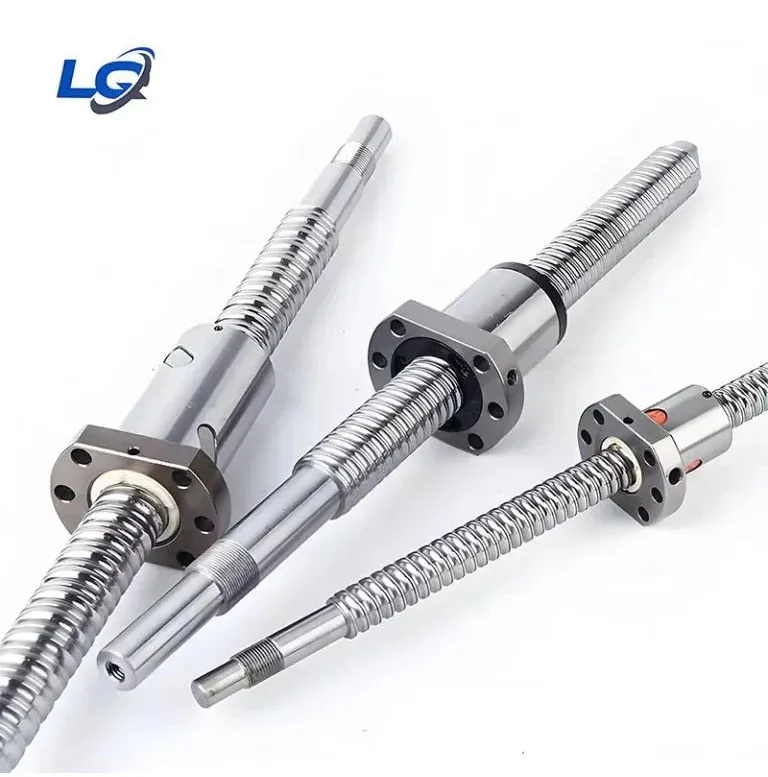
Our Husillo de bolas SFU is offered in C5 and C7 accuracy grades, in carbon steel with a milled thread and a bearing-steel nut, with a preload design available. Standard lengths and the full range of sizes are listed on the product page, and custom lengths and end machining can be made from your drawing. A machinery test report can be provided. See also our SFU ball screw size chart.
SFU ball screw with nut, supplied with machined ends to drawing.
How to choose a rack and pinion
Pick the module. Module (M) sets tooth size; pitch equals module times π. Larger modules carry more load. Common CNC modules include 1, 1.25, 1.5, 2 and 3. Our standard cremallera y piñón uses module 1.25.
Choose straight or helical teeth. Helical teeth engage gradually, so they run quieter and smoother and handle higher speed. Straight teeth are cheaper and easier to align.
Check the material and hardening. Our racks use C45 steel, with S45C and SCM440 also available, and high-frequency hardened teeth for wear resistance.
Calculate speed. Linear speed = π × module × pinion teeth × pinion rpm. For module 1.25 and a 24-tooth pinion the pitch diameter is 30 mm, so one pinion revolution moves the axis about 94 mm.
Add a gear reducer. A planetary reducer multiplies torque, lowers reflected inertia and gives finer positioning. See our reductor planetario range and the article on choosing a servo and reducer.
Plan the joints. Racks are supplied in sections. Use a pitch-setting jig when joining so the tooth spacing stays continuous across the joint.
A worked illustration: with a 30 mm pitch diameter pinion, a 5:1 reducer and a motor at 3,000 rpm, the pinion turns 600 rpm and the axis moves at about 56 m/min. Peak speed in real machines is limited by acceleration, machine mass and the controller, so treat this as a ceiling, not a target.
Reducing rack backlash
Because gear teeth need a little clearance to mesh, a rack and pinion always has some backlash. It shows up as a small dead zone when the axis reverses. Common ways to reduce it include:
Helical rack and pinion. More tooth contact gives smoother motion and less play.
Dual pinion (electronic preload). Two motors drive two pinions on the same rack, and the controller applies opposing torque so one pinion always loads the opposite tooth flank.
Spring-loaded pinion. A spring keeps the pinion pressed into the rack, at the cost of some wear.
Correct mesh adjustment. Set the centre distance carefully; too tight causes heat and wear, too loose increases backlash.
Backlash compensation in the controller. Useful for small residual play but it does not replace good mechanics.
Instalación y lubricación
Ball screw alignment. Keep the screw parallel to the linear guides, and align both end bearings. Misalignment loads the nut sideways and shortens life.
Do not remove the nut off the shaft. If it is needed, use a sleeve tool so the balls do not fall out.
Keep dust out. Use bellows covers or wipers in dusty machines such as wood and stone routers.
Lubricate. Grease the nut at regular intervals according to duty; an automatic unidad de lubricación keeps film consistent on production machines.
Rack mounting. Align the rack straight and parallel to the guides, tighten bolts evenly and check mesh at several points along the stroke.
Grease the rack teeth. Use a suitable grease and clean old grease and chips away before re-lubricating.
Resolución de problemas
Síntoma
Causa probable
What to do
Ball screw noisy or rough
Poor lubrication, misalignment, contamination
Clean and re-grease, re-align supports, fit covers
Screw whips at speed
Running near critical speed
Reduce rpm, shorten span, use larger diameter or fixed-fixed supports
Position error grows with use
Nut wear, loose coupling, lost preload
Check coupling, replace nut or screw if worn
Axis jerks on reversal (rack)
Backlash, loose pinion, soft reducer
Adjust mesh, tighten pinion, consider helical or dual pinion
Wavy cuts or step marks (rack)
Rack joint misalignment or uneven mesh
Re-set the joints with a jig, check mesh along the stroke
Teeth wear quickly
No grease, dust, too tight a mesh
Clean, lubricate, loosen the centre distance slightly
Buying ball screws and racks from a China factory
Jinan Longqiao Electromechanical Equipment Co., Ltd is a factory in Shandong, China, supplying ball screws, racks and pinions, linear guides, servo systems and spindle motors for OEMs and distributors. Points buyers usually ask about:
Cantidad del pedido y muestras: se acepta una cantidad mínima de pedido (MOQ) de 1 unidad y hay muestras disponibles.
Custom work: ball screw length and end machining, and rack module, length, holes and surface treatment, can be made to your drawing.
Registros de inspección: a machinery test report can be provided, and an outgoing-inspection video is available for racks.
OEM: Se admiten requisitos de OEM.
Shipping and payment: by DHL or sea freight, T/T and PayPal.
Garantía y repuestos: las condiciones se confirman en su presupuesto para el modelo que solicite.
For an accurate quote, send the axis stroke, load, speed, accuracy grade and quantity, ideally with a drawing. You can also look at our fábrica y certificados pages, or browse the husillo de bolas y cremallera y piñón categories.
Not sure whether your axis needs a ball screw or a rack?
Send us your stroke, speed and accuracy needs and we will recommend a drive and the matching motor and reducer.
What is the difference between a ball screw and a rack and pinion?
A ball screw converts rotation to linear motion through a screw and a recirculating-ball nut, giving high accuracy and near-zero backlash over short to medium strokes. A rack and pinion uses a gear meshing with a toothed bar, which suits very long strokes and high speeds but has some backlash.
Which is more accurate, a ball screw or a rack and pinion?
A preloaded ball screw, especially in C5 grade, is normally more accurate and stiffer. A rack and pinion can be accurate enough for routers, plasma and laser machines, but its accuracy depends on rack grade, joints, mesh adjustment and backlash control.
When should I use a rack and pinion instead of a ball screw?
Use a rack when the axis is long, roughly beyond 2 to 3 metres, or when you need fast rapids over a large bed. A very long ball screw runs into critical-speed limits and sag, while racks can be joined end to end.
What do the numbers in SFU1605 mean?
SFU1605 is a 16 mm diameter ball screw with a 5 mm lead. SFU1610 is 16 mm with a 10 mm lead, SFU2005 is 20 mm with a 5 mm lead and SFU2505 is 25 mm with a 5 mm lead.
How do I choose the lead of a ball screw?
Lead times screw rpm gives linear speed. A 5 mm lead gives finer resolution and more thrust; a 10 mm lead moves twice as fast at the same rpm but needs more motor torque. Pick the lead from your required speed, load and motor.
What is critical speed and why does it matter?
Critical speed is the screw rotation speed at which it starts to whip and vibrate. It depends on root diameter, unsupported length and end supports. Keep the working speed below about 80 percent of the calculated value.
What is the difference between C5 and C7 ball screws?
C5 is a higher precision grade than C7 with tighter lead accuracy. C7 is widely used on general CNC machines and automation, while C5 is chosen where positioning accuracy matters more.
How can I reduce backlash on a rack and pinion?
Use helical teeth, a dual-pinion setup with electronic preload, or a spring-loaded pinion, set the mesh distance correctly, and add controller backlash compensation for small residual play.
Do I need a gear reducer with a rack and pinion?
Usually yes. A planetary reducer multiplies torque, lowers reflected inertia and improves positioning resolution, which helps the servo hold the axis steady. The ratio depends on speed, load and pinion size.
Can you make ball screws and racks to my drawing?
Yes. Ball screw length and end machining, and rack module, length, holes and surface treatment can be customised from your drawing. Send the drawing and quantity for a quotation.