
A good lubrication system does more than add oil or grease. It delivers the right lubricant, to the right place, at the right time. For CNC equipment and industrial machinery, this can reduce friction, control wear, simplify maintenance, and support better equipment reliability.
This guide explains how an automatic lubrication system works, how it differs from manual lubrication, which system types are common, and how to select a suitable lubrication unit for linear guides, ball screws, bearings, gears, and other moving parts.
A lubrication system moves lubricant from a storage source to one or more moving surfaces. A basic system may include a reservoir, pump, pipe or hose, fittings, a valve, and each required lubrication point. More advanced systems add a timer, pressure monitoring, alarms, and a control system.
The goal is simple: keep a suitable lubrication film between surfaces that slide, roll, or rotate. This helps reduce direct metal-to-metal contact, heat, noise, and premature wear.
On CNC equipment, a lubrication unit may serve:
For LONGQIAO customers, lubrication is often part of a larger motion package. A machine builder may source linear guides, ball screws, motors, spindle components, and the lubrication equipment that protects those parts from the same supplier.
LONGQIAO’s current range includes manual oil pumps, 2 L and 3 L electric grease pumps, and an automatic grease pump designed for CNC and industrial applications.

A major weakness of manual lubrication is inconsistency. The machine may need lubricant every few hours or after a certain number of cycles, but people get busy. A point may be missed, lubricated too late, or given the wrong amount of lubricant.
Automatic lubrication reduces that dependence on operator memory. A pump can deliver lubricant at planned intervals while the machine is operating. This supports more consistent lubrication of difficult-to-reach components and can help reduce maintenance effort.
SKF describes centralized automatic systems as combinations of a pump, distributors or feeders, and optional control and monitoring devices. The goal is to deliver controlled lubricant quantities at defined intervals. SKF also connects this approach with greater machine availability, reduced wear, and simplified maintenance. SKF Media Hub
Perma makes a similar point for automatic single-point systems: regular small quantities of fresh lubricant can reduce the risk of under-lubrication and make maintenance work easier.
This does not mean any auto lubrication systems will automatically extend equipment life. The type of lubricant, interval, pressure, line size, environment, and component requirement still need to be correct.
The value comes from effective lubrication, not automation alone.
Neither method is always better.
A small attended machine with only a few points may work well with a simple hand-operated lubrication pump. A large production machine with many guides, screws, and bearings may benefit much more from centralized lubrication.
| Factor | Manual System | Hệ thống tự động |
| Initial complexity | Thấp | Cao hơn |
| Electrical power | Often not required | Usually required |
| Operator involvement | Cao | Thấp |
| Many lubrication points | Less convenient | Better suited |
| Unattended production | Limited | Strong advantage |
| Timing consistency | Operator-dependent | Programmable or cyclic |
| Monitoring | Usually visual | Can include pressure and alarms |
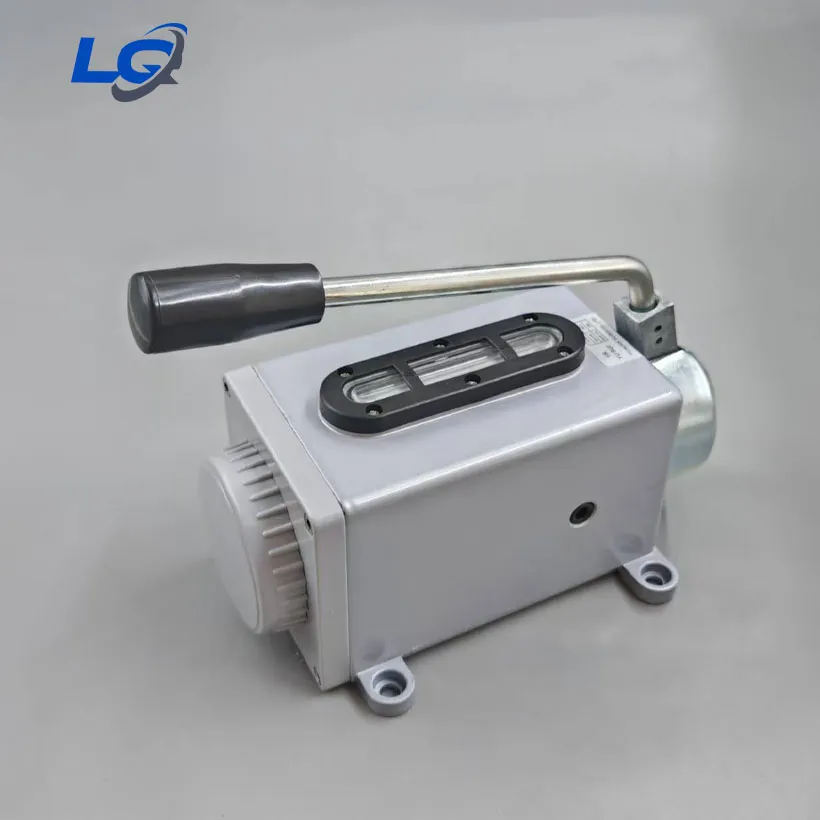
LONGQIAO’s HP-5 is an example of a simple manual oil solution. It uses a hand lever, a transparent 0.5 L reservoir, and requires no electrical supply. The published specification lists a rated flow of 5 ml/min. It suits equipment where periodic operator-controlled oil lubrication is enough.
Cái Y-8 follows another manual approach. It has a 500 cc die-cast aluminum body, hand crank, oil-level window, internal filter, and single- or double-outlet options for 4 mm or 6 mm pipe.
For unattended operation, frequent cycles, or many lubrication points, an automatic lubrication system usually offers a more practical path.
The first selection question is not pump size.
It is oil or grease?
Oil flows easily and works well in applications where the system needs frequent delivery or circulation. Grease stays in place longer and is often useful where loads are higher, sealing support is useful, or frequent oil flow is not practical.
However, oil and grease are not interchangeable. A pump designed for thin oil may not move thick grease correctly. A grease pump usually needs more pressure because grease has much greater resistance in tubing and fittings.
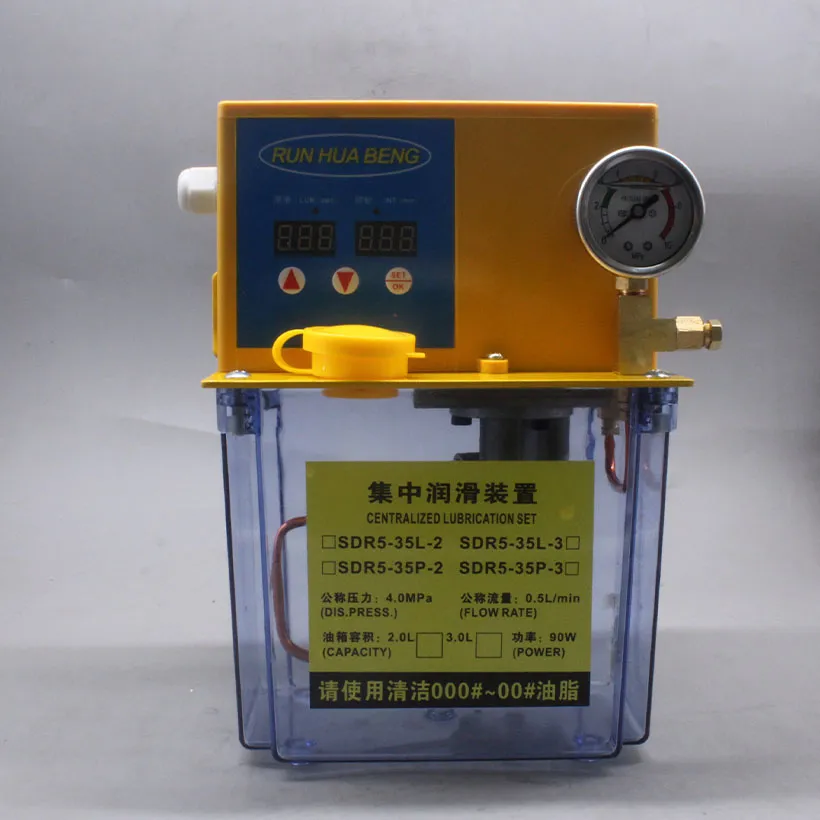
LONGQIAO’s current 2 L and 3 L electric products are specified for clean 000#–00# grease. Both product-family specifications state a 90 W electric drive, nominal pressure of 4.0 MPa, and nominal flow of 0.5 L/min.
By contrast, the HP-5 and Y-8 are oil-supply products.
The correct lubricant should also match:
Perma notes that lubricant choice depends on the application and that selecting the correct lubricant, location, timing, and quantity is central to good lubrication practice.
For buyers, the rule is simple: choose the lubricant first, then choose a compatible lubrication unit.

There are many different types of lubrication in industrial equipment. They should not all be treated as the same solution.
Single-Line Lubrication
A single-line system uses one main supply line from a central pump to metering devices. Each outlet feeds a specific lubrication point.
SKF describes single-line systems as suitable for oil, fluid grease, and grease, depending on the system design. They are commonly used on machine tools and other industrial applications. SKF Media Hub
A single line parallel or parallel system can use metering valves so individual points receive controlled quantities.
Dual-Line Systems
A dual-line system uses two main lines that operate alternately. These systems are common where long distances, many points, or demanding industrial machinery make a single supply line less practical.
Progressive System
A progressive system sends lubricant through a progressive divider. The outlets operate in sequence, which can make distribution and blockage monitoring easier in some applications.
Multi-Point Direct Systems
A multi-point direct arrangement uses separate pump outlets or dedicated lines to individual locations. It can simplify control on equipment with a moderate number of points.
Oil Circulation Lubrication
Oil circulation lubrication returns oil to a reservoir for filtering, cooling, and reuse. It is used where lubrication also helps remove heat.
Mist and Minimum Quantity Lubrication
A mist lubrication system uses air to carry very small oil droplets to a component or process area. MQL, or minimum quantity lubrication, is often associated with the cutting process rather than centralized lubrication of a guide rail or ball screw.
SKF separates centralized lubrication from minimum quantity lubrication because they solve different problems. SKF Media Hub
This distinction matters. Do not order a mist system when you actually need an automatic guideway grease supply.
A central lubrication setup starts at the reservoir.
The pump creates pressure and pushes the lubricant into the main line. From there, distributors, a meter, injectors, or other metering devices divide the flow between points.
A typical path looks like:
Reservoir → Pump → Main Line → Distributor / Valve → Lubrication Point
More advanced centralized lubrication systems may also include:
Some designs use a piston metering element. Others use gear-type pumping structures. A pneumatic pump may use compressed air rather than an electric motor.
The exact design depends on how many points the machine has and how far the lubricant must travel.
This is why pump pressure alone is not enough to size a system.
A strong pump connected to the wrong lines or wrong metering devices can still result in poor delivery.
For optimal lubrication, every branch should receive the required quantity without starving another part of the system.
| LONGQIAO Product | Main Type | Confirmed Main Features | Suitable Direction |
| HP-5 | Manual oil pump | 0.5 L, hand lever, no electrical power | Periodic attended lubrication |
| Y-8 | Hand-cranked oil pump | 500 cc, visible oil level, single/double outlet | Maintenance and traditional machine tools |
| 2 L Grease Pump | Electric grease unit | 90 W, 4.0 MPa, 0.5 L/min, 000#–00# grease | Centralized multi-point supply |
| 3 L Grease Pump | Electric grease unit | 3 L reservoir, same published pump-family ratings | Longer refill intervals / more grease demand |
| Automatic Grease Pump | Timed electric unit | 220 V, digital timing, pressure gauge, alarms/protection | Higher automation requirement |
LONGQIAO‘s automatic grease product adds functions such as adjustable lubrication duration and interval, power-off memory, pressure monitoring, low-level alarm, pressure relief after shutdown, and overheat or overload protection, according to the current product information.
This makes it more suitable for long-running equipment where a simple manual lube routine is not enough.
For OEM buyers, there is another advantage. LONGQIAO also supplies linear guides, ball screws, servo and stepper systems, spindle motors, planetary reducers, and rack drives. That means the lubrication requirement can be discussed together with the components being protected.
That integrated approach can simplify machine development and repeat sourcing.
The full LONGQIAO lubrication range is designed for CNC equipment, woodworking machines, cutting equipment, automation lines, and other machine applications.
Start with the machine, not the catalogue.
For new designs, list every component that must be lubricated. Record the lubricant requirement, travel distance, cycle frequency, orientation, environmental conditions, and production hours.
Then decide whether the equipment requires:
Manual → Centralized → Automatic → Monitored
For a simple attended machine, the HP-5 or Y-8 may provide the ideal lubrication approach.
For multiple grease-fed points, a 2 L or 3 L electric unit may offer a better balance between capacity and automation.
For long production periods and machines where regular intervention is undesirable, a timed automatic unit with monitoring may be more suitable.
Also consider efficiency and safety. Perma notes that remote mounting can help when a lubrication point is difficult or unsafe to reach while equipment is operating. perma-tec.com
The best lubrication solutions do not simply add more hardware. They make the lubrication task easier, repeatable, and suitable for the real duty cycle.
For LONGQIAO OEM and distributor customers, that means the lubrication equipment can also be matched with the linear guides, ball screws, bearings, rack drives, and other CNC components being sourced for the same project.
That is the real value of a one-stop approach: fewer separate sourcing steps and better visibility across the complete machine system.