
LONGQIAO Technical Team | Product & Applications | Published September 1, 2026
CNC linear guides fall into three practical families — ball-type profile rail, miniature profile rail, and self-lubricating profile rail — and the right one for a given machine depends less on the machine’s name than on its load pattern, duty cycle, and how clean the environment around the axis actually is.
A CNC router and a CNC plasma table can share a frame layout, a gantry design, and even a control board — and still call for different linear guide choices, because what wears the bearing isn’t the machine category, it’s what the axis is exposed to while it runs. A router throws wood dust into every open surface near the gantry. A plasma table throws slag, heat, and occasionally metal fines that are sharper and more abrasive than wood dust ever gets. Same-looking frame, different failure mode.
This guide works through four common CNC platforms — router, plasma, laser, and mill retrofit — and matches each to the LONGQIAO profile rail family that fits its actual operating conditions, then covers the part most selection guides skip: the mounting surface itself, because a correctly specified rail bolted to a poorly prepared surface won’t deliver its rated performance regardless of which family you picked.
The Three Rail Families, Briefly
Each of these shows up differently depending on what machine they’re bolted into.
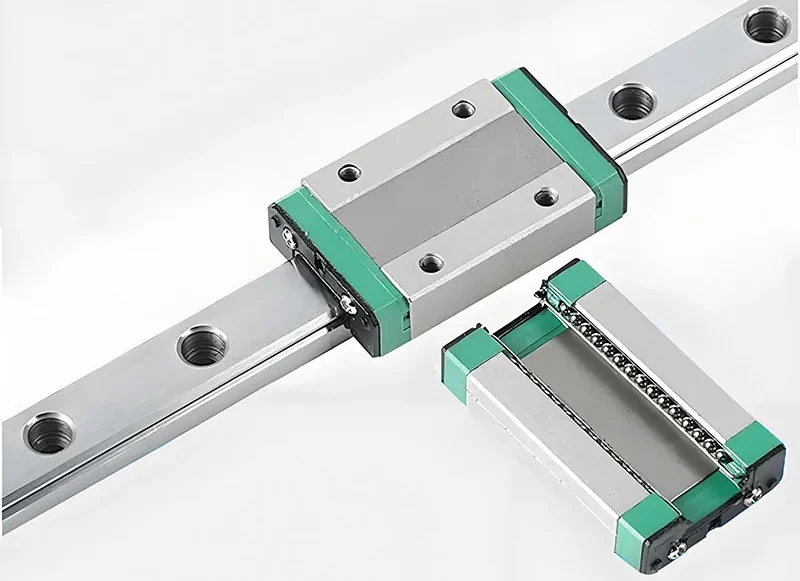
Router gantries run wood, MDF, and composite dust continuously, and that dust is fine enough to work into an exposed rail if the wiper seals aren’t doing their job or the rail sits directly under the dust collection path. HGR guides are the standard choice here because router axes are cycling constantly across a work session and need the load capacity and repeatability that a ball-type rolling structure holds onto over high cycle counts. On smaller desktop or hobby-class routers where the gantry itself is light, MGR’s compact footprint can be the better fit — there’s no reason to mount a full-size HGR block on a gantry that never sees the load capacity it’s rated for.
Where builders get this wrong: mounting the rail directly beneath the spindle’s dust extraction path without any shielding, so the wiper seals are fighting a constant stream of fines instead of occasional exposure.
Plasma introduces two things a router doesn’t: heat radiating up from the cut, and slag — small, hot, sometimes sharp metal particles that settle on anything nearby, including exposed rail surfaces. This is where EGR’s low-friction, self-lubricating structure earns its keep, because a plasma table that’s out on a shop floor doesn’t always get the lubrication discipline a precision mill would, and reduced maintenance dependency matters more here than squeezing out maximum load capacity. For the gantry’s primary travel axis carrying real load, HGR remains the default; EGR is frequently the better call on a secondary or Z-axis where duty cycle is lower but neglect is more likely.
LONGQIAO’s laser-related production line grew directly out of supplying parts for engraving machine builders, so this is closer to home than the other three. Laser gantries are typically lighter than router or plasma frames and prioritize smooth, low-vibration travel over raw load capacity — vibration at the wrong frequency shows up directly as a wavy cut edge or an engraving artifact. MGR fits smaller desktop and mid-size laser platforms well for this reason; HGR moves in once the bed size and cutting head assembly push total moving mass up enough that MGR’s load ceiling becomes the limiting factor rather than the footprint constraint MGR was chosen to solve.
Retrofitting a manual mill to CNC is a different problem from any of the above three, because the frame wasn’t designed around the linear guide from the start — you’re fitting the rail to an existing casting, and mounting surface condition becomes the dominant variable rather than an afterthought. HGR is almost always the right family here on account of the load a milling operation puts through the axis, but the guide’s rated accuracy is only as good as the surface it’s bolted to, which is exactly why mounting prep gets its own section below rather than a passing mention.
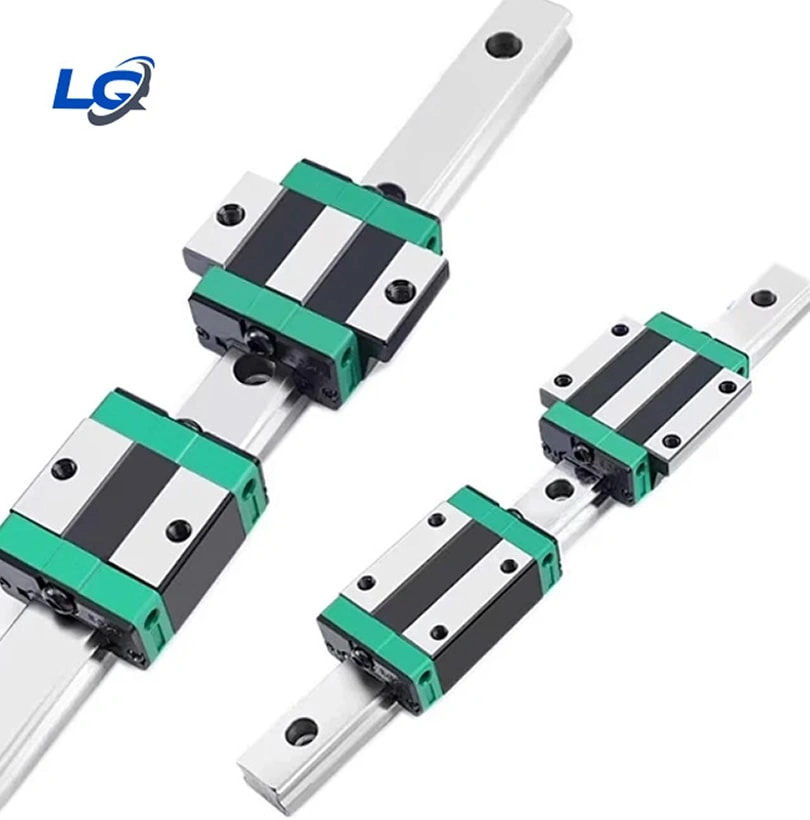
A rail’s accuracy rating describes the rail — not the axis you build with it. Bolt a correctly specified HGR rail to a surface that isn’t flat, and the rail will follow that surface’s imperfections, introducing binding, uneven wear, or positioning error that has nothing to do with the rail itself and everything to do with what it’s mounted on. Three things decide whether the mounting surface actually delivers what the rail is capable of:
The single most frequent mounting error isn’t a torque or alignment mistake — it’s skipping the flatness check entirely because the frame was fabricated to spec on paper. Welding introduces stress that doesn’t always show up until the frame has cooled and sat for a while, and a mill retrofit built on an older casting can have decades of accumulated wear on the mounting face that a visual check won’t catch. A straightedge check takes minutes; diagnosing intermittent binding on an assembled axis months later takes considerably longer.
| Rail Family | Struktur | Best-Fit Machine Type | Load Capacity | Maintenance |
| HGR Linearführung | Ball-type, three-side ground rail | Router primary axis, plasma primary axis, mill retrofit | Higher, built for repeated cycling | Periodic, standard interval |
| MGR Miniatur-Linearführung | Compact profile | Desktop/mid-size laser, light gantries | Lower ceiling, high capacity-to-footprint | Periodic, standard interval |
| EGR Linearführung | Self-lubricating, low friction | Plasma secondary/Z-axis, low-attention environments | Mäßig | Reduced — self-lubricating |
Where accuracy classification comes up in supplier conversations generally, JIS B 1192 and comparable DIN conventions define the industry’s standard accuracy-grade naming (C/H/P/SP/UP) for linear rolling guides — useful background for comparing datasheets across suppliers, though LONGQIAO does not currently publish rail-specific accuracy class ratings and can confirm tolerance requirements against a specific application on request.
Once the axis is mechanically sound, matching the right rail configuration to your specific frame dimensions and duty cycle is worth confirming directly — LONGQIAO provides a machinery test report and video outgoing inspection with rail orders, and can advise on family selection for a retrofit or new build; contact us for a quotation once the axis specification is set.
A: Yes, and it’s common on machines where axes carry different loads — a heavier X-axis gantry on HGR and a lighter Z-axis on MGR is a normal configuration, provided each axis is sized to its own load and duty cycle rather than matched to the other axis for consistency’s sake.
A: The self-lubricating structure extends the interval, it doesn’t remove maintenance entirely — duty cycle and contamination exposure still determine how often the axis needs attention, just less often than a standard rail on the same machine.
A: The accuracy requirement depends on the operation, not the fact that it’s a retrofit — a mill cutting metal to tight tolerances generally demands tighter positioning accuracy than a router cutting wood or foam, regardless of which machine started life manual.
A: Contamination getting past the wiper seals is the most common cause across router, plasma, and laser platforms alike — closely followed by mounting surfaces that weren’t checked for flatness before the rail went on.
A: It’s the safer default for load capacity, but not automatically the right call — a lightweight laser gantry or a footprint-constrained desktop machine can be over-served by HGR’s size and cost when MGR would have done the job.
If your retrofit or new-build axis doesn’t fit neatly into router, plasma, laser, or mill retrofit — a custom gantry, a multi-axis fixture, an unusual span length — the load pattern and contamination exposure still drive the choice the same way; send us the frame dimensions and duty cycle and we can work through which family fits.