
A small error in tool height can turn a good program into scrap. Repeat that across tool changes, and setup time, rework, and operator dependence grow fast. A reliable setter gives the control a repeatable reference before cutting starts.
A CNC tool setter is a contact or non-contact measuring device that detects a cutting tool’s position so the control can establish tool length, diameter, or condition and update offsets. On routers, it commonly sets Z height; on machining equipment, it can also support radius checks, wear monitoring, and broken-tool detection when the control program supports those functions.
A tool setter is a device used to establish a repeatable reference for a cutting tool before or during machining operations. Instead of asking an operator to touch the cutter against a workpiece, paper, gauge block, or reference plate manually, the equipment detects contact and sends a signal to the control.
The control then uses that position to calculate an offset. This tells the program where the cutting edge is located relative to the workpiece and the programmed coordinate system. Accurate tool data matters because the software may have the correct tool path, but the part can still be cut too deep or too shallow if the physical cutter position is wrong.
This is why setters are widely used on CNC machines such as routers, mills, machining centers, and some turning equipment. Renishaw defines tool setting as determining geometric data such as length, radius, and diameter, and notes that the same technology can also support tool-condition and breakage checks. renishaw.com
At LONGQIAO, we supply both woodworking and metalworking solutions through our Ajustador automático de herramientas product range, allowing OEMs and retrofit buyers to match the product to the equipment rather than using one design for every application.
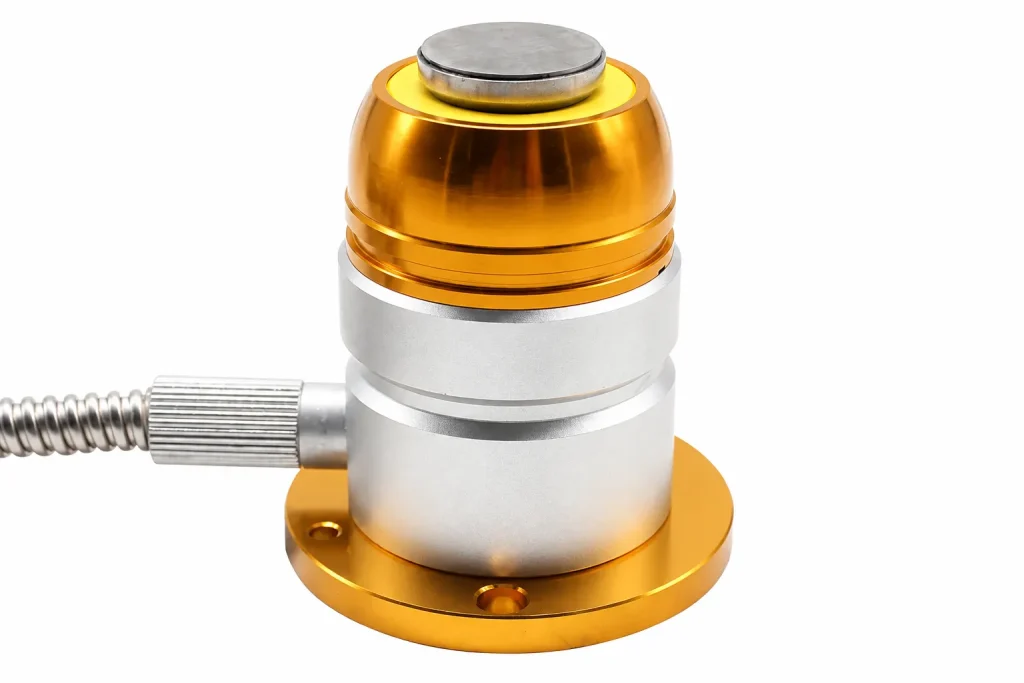
A contact setter works through a simple sequence.
The control moves the cutter toward the contact surface at a defined feed rate. When the cutter touches the surface, an internal sensor or switch changes state. The signal travels to the CNC controller, which records the current axis coordinate. The software then applies the required correction.
A typical cycle is:
Approach → Tool Touch → Trigger Signal → Coordinate Capture → Offset Calculation → Resume Program
On a woodworking router, the cutter normally approaches from above along the Z-axis. Once contact occurs, the system establishes the reference used for depth control. LONGQIAO’s JQ-66SR follows this fixed-contact principle and uses a four-wire connection to communicate with compatible controls.
The same principle becomes more advanced on metalworking equipment. A setter with a suitable control cycle can measure the top and sides of a cutter. That allows the system to calculate length or cutter size instead of only setting height. Renishaw explains that contact setters can handle length and radius checking as well as broken-tool detection, depending on hardware and software.
The important point for buyers is that the hardware alone does not create every function. The controller, wiring, input logic, macro, and program must all support the requested cycle.
The names sound similar, but the workflow is different.
An on-machine setter measures the cutter while it is mounted in the spindle. A tool presetter normally measures it outside the equipment before the cutter is installed.
| Comparison | On-Machine Setter | Offline Presetter |
| Measuring location | Inside equipment | Separate measuring station |
| Main use | Update offsets directly during setup or production | Measure cutter before loading |
| Setup workflow | Integrated into machining cycle | Requires data transfer |
| Wear checking | Possible with suitable cycle | Usually before installation |
| Broken-tool check | Possible on suitable systems | Not an in-cycle check |
| Best fit | Automated production and repeat setup | Centralized tool preparation |
Both approaches can work well. The difference is where the measurement happens and how the data enters the control.
HEIDENHAIN notes that measuring cutters directly inside the equipment avoids differences that may occur when tools are measured away from the actual machining environment. Its touch probes can measure length and radius and monitor wear or breakage directly on the equipment.
For buyers designing a new CNC machine tool, the choice should therefore consider production flow, control capability, available space, number of cutters, and how often tool changes occur.
The answer depends on the product and the control program.
The simplest type establishes tool length or a Z reference. More capable systems can also measure cutter diameter, monitor wear, or check whether a cutter has broken.
LONGQIAO currently has two distinct product directions.
| Parámetro | JQ-66SR Woodworking Setter | Machining Center Setter |
| Estructura | Fixed-contact Z measuring device | Wired contact measuring device |
| Main function | Tool length and Z reference | Length, diameter, wear and breakage checking |
| Contact size | Approx. 20 mm | Approx. 20 / 30 / 50 mm |
| Signal | 4-wire, normally closed; confirm before order | 4-wire NC or 6-wire NO |
| Protection | Sealed woodworking structure | IP68 |
| Contact surface | Fixed contact surface | Almohadilla de contacto de carburo |
| Main use | Router, nesting, engraving | Milling and machining equipment |
| Repetibilidad | Not published on current product page | Hasta 0,001 mm |
The JQ-66SR is designed mainly to establish a repeatable height reference. You can see the detailed specifications on the JQ-66SR woodworking tool setter page. LONGQIAO specifies an approximately 20 mm contact surface, aluminum-alloy base, sealed structure, four-wire connection, and a stated contact life of more than three million operations. 济南龙桥机床零件
The metalworking version offers more functions. The machining center tool setter supports length and size checking, wear monitoring, and broken-tool routines when the program supports them. Its published specification lists repeatability of up to 0.001 mm and IP68 protection.
These values describe that specific product. They should not be treated as a universal specification for every setter.
Every cutter has a physical length. Two end mills that look almost identical can still differ enough to affect cutting depth.
If a new cutter is loaded but the old offset remains in the control, the cutting edge may reach the material at the wrong height. That can create an undersized feature, excessive depth, poor finish, or scrap.
Automated tool measurement reduces dependence on a manual process. The system can capture the reference consistently instead of asking different operators to judge contact by feel.
This is especially useful after:
Renishaw identifies reduced setup time, lower operator-entry risk, automatic wear compensation, and in-cycle breakage detection as key benefits of on-machine setting. renishaw.com
The result is not that the probe magically makes the whole machine more accurate. Final precision still depends on the spindle, frame, guides, transmission, thermal condition, calibration, control, and cutting process. The setter simply gives the control more reliable cutter data.
A woodworking router and a metalworking mill may both need an accurate tool reference, but their working environments and required functions are different.
For a CNC router, the main task is often fast height setting after cutter replacement. Dust and chips are important concerns. LONGQIAO’s JQ-66SR therefore uses a compact fixed-contact structure with a sealed body and is intended for routing, drilling, grooving, relief carving, nesting, and panel processing.
Buyers developing woodworking equipment can also review LONGQIAO’s CNC router parts for woodworking machinery solution, which combines guides, screws, drive components, spindle systems, and related accessories for long-hour woodworking applications.
Metalworking places different demands on the measuring device. Chips and coolant are common, and the user may need more than height setting. LONGQIAO’s metalworking design uses a carbide contact pad, IP68 protection, and multiple contact sizes. It can support cutter-size, wear, and breakage routines.
For a mill, this can help the control maintain more consistent cutter compensation throughout batch production.
The same basic idea applies across different equipment: determine cutter geometry, then store or correct the value in the control.
On a router, the key reference is usually vertical position. The machine lowers the cutter until contact and uses that event to establish height.
On a milling system, the same device can support top and side probing. The program may use different approach directions to obtain cutter length or size. HEIDENHAIN describes tool touch probes that can measure the length and radius of milling cutters, individual teeth, wear, and breakage.
A CNC lathe uses a different cutter arrangement. Turning tools do not behave like rotating router bits, so the probing geometry changes. Dedicated systems may use a touch arm or contact face to determine the turning insert position. Renishaw and HEIDENHAIN both document tool-setting applications for turning equipment. renishaw.com
This is why buyers should never select the tool setter only because the seller calls it “universal.” The measuring direction, cutter type, control logic, and physical dimension all need to fit the application.
Start with the control and application, not price.
At LONGQIAO, one of the first things we recommend checking is signal compatibility. A mechanically suitable setter is still unusable if its electrical output or macro logic does not match the control.
A practical selection checklist includes:
The JQ-66SR lists compatibility with Weihong, Syntec, Shanlong, and Mach3, subject to correct signal and program matching. The metalworking model offers alternative contact sizes and wiring configurations to suit more installation layouts.
For new equipment, consider the setter at the design stage rather than adding it after everything else. That gives the designer more freedom for cable routing, mounting, probing clearance, and controller I/O.
Good hardware can still give poor results when installation is wrong.
First, the contact surface must sit in a location the cutter can approach safely. The travel must leave enough clearance for the spindle, holder, cutter, fixture, and setter body.
Second, the signal should be tested before running an automatic cycle. Confirm the switch state, input terminal, voltage, grounding, and program logic. The control should stop the probing move immediately when the contact triggers.
Third, calibrate the reference. The control needs to know the known setter height or another reference value before it can calculate the cutter position correctly.
A safe commissioning sequence is:
Mount → Wire → Verify Signal → Calibrate → Test Slowly → Run Automatic Cycle
Never begin with full-speed movement.
The working surface should also stay clean. Dust, chips, coolant residue, or a damaged contact face can change the trigger point. Even an IP-rated device still requires proper mounting and cable sealing.
The tool setter probe should therefore be treated as part of the complete control loop, not as a stand-alone switch.

The largest benefit often appears between cutting cycles rather than during them.
Imagine a production job that uses several cutters. Without automated setting, the operator may stop the equipment, measure each new cutter, enter data, verify the values, and make a trial cut. Repeating this several times a shift adds non-cutting time.
With a compatible setter, the control can automate much of that sequence.
This creates reduced setup time and can help standardize the process between operators. It also supports a more efficient tool changer workflow because the system can check a cutter after selected tool changes instead of relying entirely on manual entry.
Renishaw notes that on-machine systems can automatically update cutter data and reduce the risk of an operator entering an incorrect value into the control. renishaw.com
The same approach can support unattended production. For example, a program may check that a cutter still reaches the expected point. If it does not, the CNC control can stop the cycle or raise an alarm rather than continuing to produce bad parts.
That does not mean every system automatically provides these features. The software must be configured for them.
A setter rarely exists alone in a new equipment project.
The same OEM may also need linear guides, ball screws, a servo system, spindle, planetary reducer, cable carrier, and lubrication components.
Buying each item from a different supplier creates more quotations, more shipping arrangements, and more compatibility checks.
LONGQIAO focuses on one-stop CNC parts sourcing for OEMs, distributors, trading companies, automation integrators, and equipment manufacturers. Our current range covers linear-motion products, ball screws, stepper and servo systems, spindle motors, reducers, racks, setters, lubrication equipment, and related accessories.
For metalworking projects, buyers can review our CNC machining center parts solution. For broader sourcing, our one-stop CNC machine parts capabilities explain how we support new equipment, mass production, distributors, and replacement-parts demand.
This matters when an OEM scales from prototype to series production. A supplier that can support several related components may reduce sourcing time and simplify repeat purchasing.
It also gives the buyer one place to discuss compatibility. For example, a setter project may also involve spindle clearance, the Z travel, control I/O, and cable routing. Those details cross several component categories.
Yes, when the control and measuring program support it. The cutter contacts the measuring surface, the control records the coordinate, and the software calculates the required correction. LONGQIAO’s woodworking unit is designed mainly for height reference, while the machining-center version supports more advanced functions.
Some products can. The machining-center model can support top-contact length checking and side-contact size checking when the required cycle is available. The cutter may need to approach the contact pad from different directions.
No. A setter measures the cutting tool. A workpiece probe generally detects part position, size, or datum features. Both may use touch-trigger technology, but they solve different problems.
Often yes. Buyers need to confirm mounting space, wiring, control input, macro support, and safe approach travel. LONGQIAO lists both woodworking and machining-center products for new builds and retrofit applications.
Yes, if the product and program support the function. A typical routine expects contact within a known position range. If the cutter fails to trigger the probe where expected, the program can stop or generate an alarm. Renishaw also identifies broken-tool detection as a standard application of many on-machine systems.