
LONGQIAO Technical Team | Product & Applications | Published September 3, 2026
A catena portacavi protects and guides moving cables and hoses on a CNC or automation axis, and most early failures trace back to four install decisions — how full the chain is packed, whether bend radius respects the cables inside it (not just the chain itself), whether cable types are separated, and how much of the run is left unsupported.
Drag chain doesn’t usually fail because the chain itself was wrong for the application — it fails because of how it was filled and installed. The chain’s own rated bend radius is only half the equation; the cables and hoses running through it have their own minimum bend radius from their own manufacturer, and if that number is tighter than what the chain enforces, the cable is what breaks down first, chain link by chain link, invisibly, until it doesn’t. Overfilling compounds the same problem by giving cables no room to shift as the chain flexes on each cycle. Mixing power and signal cable without separation adds electrical noise and abrasion between conductors that weren’t designed to rub against each other thousands of times a day. And an unsupported span left to sag under its own weight puts a slow, cumulative stress on the chain links that a properly supported run never sees.
None of these show up on day one. They show up as intermittent faults, chafed insulation, or a chain that starts sagging or binding months into service — by which point the fix costs a production stop, not five extra minutes at install.
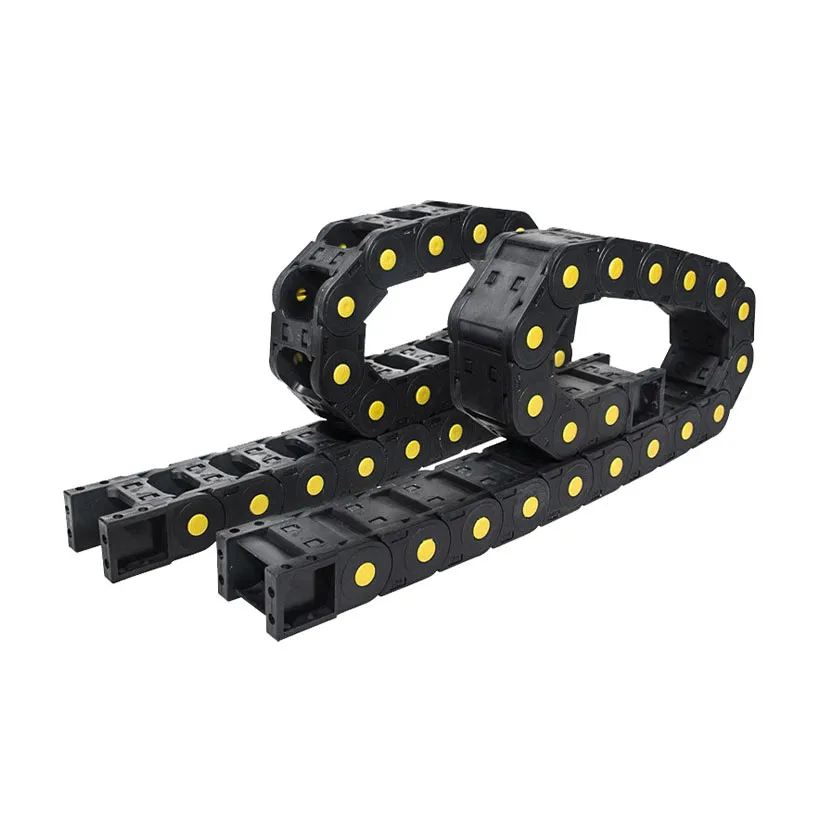
Add up the cross-sectional area of every cable and hose that will run through the chain, then compare it against the chain’s usable interior cross-section. Packing a chain to its visual capacity isn’t the target — cables need clearance to shift position slightly as the chain bends through its cycle, and a chain filled without that margin wears its contents against each other on every single travel cycle. If the fill calculation comes out close to capacity, size up rather than forcing a tight fit.
Pull the minimum bend radius spec for every cable and hose going into the chain — not just the heaviest one, all of them — and compare each against the chain’s bend radius at the tightest point of its travel. The chain’s rated bend radius is a ceiling on what it will physically allow, but it doesn’t guarantee any individual cable inside is happy at that radius. Whichever number is tighter, the cable’s minimum or the chain’s radius, is the one that governs. If any cable’s minimum bend radius exceeds what the chain provides, that cable is being over-flexed on every cycle regardless of what the chain itself is rated for.
Power cable, signal cable, and pneumatic or hydraulic hose shouldn’t share the same compartment inside the chain if separators are available for the series you’re using. Separation does two things: it keeps cables from abrading against each other as the chain flexes, and it reduces electrical interference between power and signal runs that would otherwise sit bundled together for the axis’s full travel length. Skipping separators to save a few minutes at install is one of the more common shortcuts that shows up later as intermittent signal noise nobody can trace back to the chain.
A drag chain run is either fully supported along a trough or track, self-supporting across an unsupported span, or some combination of both depending on travel length and orientation. Self-supporting travel works within the chain’s rated unsupported span for its size and fill weight — beyond that span, the chain sags under its own weight plus its contents, which stresses the links at the point of maximum droop on every cycle. If your travel length is close to what the chain can self-support, don’t assume it’ll be fine; add a support trough for at least the questionable portion of the run rather than finding out after link wear shows up.
Cables should run parallel to each other along the chain’s length, not crossed or twisted at any point in the run. A twist introduced during install doesn’t resolve itself — it becomes a stress point that the chain flexes around on every cycle, concentrating wear at that one spot instead of distributing it evenly across the cable’s length.
Every cable needs strain relief where it enters and exits the chain at both the fixed end and the moving end — not just wherever seems convenient. Without it, the cable’s own weight and the chain’s motion transfer stress directly onto the cable’s termination point, which is usually the first thing to fail if it’s left unsecured.
Before final tie-down and cover closure, run the axis through its complete travel by hand or at low speed and watch the chain’s full cycle — check for cables pinching at the bend radius, the chain contacting anything along its path, and any point where the fill looks tighter than it did sitting still. It’s far easier to adjust dress and routing before everything is finally secured than after.
Cables and hose can settle slightly within the chain during the first few days or weeks of real duty cycles, even when the initial install looked correct. A short follow-up check after run-in — confirming fill hasn’t shifted, dividers are still doing their job, and no chafing has started — catches problems while they’re still a five-minute fix.

The install error that causes the most downstream failures isn’t a chain sized too small for its cable count — it’s assuming the chain’s own bend radius rating automatically protects every cable inside it. A chain rated for a given bend radius is a mechanical limit on the chain itself; it says nothing about whether a specific hydraulic hose or a fiber-rated cable can tolerate flexing at that same radius thousands of times without degrading. Checking the cable spec sheet, not just the chain spec sheet, is the step that gets skipped most often.
Under the EU Machinery Directive, moving cables and hoses on CE-marked equipment need to be adequately guided and protected during operation — which is a large part of why drag chains exist on machinery destined for European markets in the first place, beyond simple cable management convenience.
Plastic drag chain is the common choice for standard indoor machine tool and automation environments — lighter, quieter in operation, and generally the more economical option for typical duty cycles. Metal drag chain earns its place in environments plastic isn’t built for: sustained high heat, exposure to hot metal chips or slag, or situations where impact resistance matters more than weight or noise. The right call depends on your environment more than a general preference for one material over the other — if you’re unsure which fits your application, contact us with the operating environment and duty cycle and we can help narrow it down rather than guessing from a general material comparison alone.
⚠️ Our current product catalog does not list specific chain series dimensions, pitch, or load ratings for Catena portacavi — see the production notes at the end of this article for what’s needed before those figures can be published.
A: There’s no universal percentage that applies to every chain and cable combination — the safer approach is checking your specific chain series’ rated fill capacity against your actual cable cross-section total, and leaving margin rather than filling to the calculated maximum.
A: If you’re mixing power and signal cable, separators help regardless of count — the interference and abrasion risks aren’t only a large-bundle problem, they show up at smaller scales too, just less dramatically at first.
A: Repeated flexing at a radius tighter than the cable’s rating fatigues the conductor or fiber inside over many cycles — it typically doesn’t fail on day one, it degrades gradually until an intermittent fault or full break shows up, often without an obvious external sign on the cable jacket.
A: Yes, this is common — a trough-supported section leading into a self-supporting span at the point of travel is a normal configuration, as long as the unsupported portion stays within what the chain and its fill weight can self-support.
A: Not automatically — metal chain adds weight and cost, and in a standard indoor environment without heat or abrasive exposure, it doesn’t buy you anything plastic chain doesn’t already handle. “Safer” depends on matching the material to the actual environment, not defaulting to the more rugged-sounding option.
A: Beyond the initial run-in check, inspection frequency depends on duty cycle and environment — a high-cycle production axis warrants more frequent checks than a low-cycle fixture, but any periodic maintenance schedule for the machine is a reasonable point to fold in a quick chain and cable check rather than treating it as a separate task.
If you’re specifying a drag chain for a new axis and aren’t sure whether your run needs full support, partial support, or self-supporting travel, send us your travel length, orientation, and approximate cable bundle weight and we can help work through it before the chain is ordered rather than after.