
LONGQIAO Technical Team | Product & Applications | Published August 31, 2026
A linear bearing is any component that lets a carriage move in a straight line while carrying load — the category splits into rolling-element (ball) types and sliding (plain/bushing) types, then further into profile rail, round supported rail, and unsupported shaft configurations.
Ask five machine builders which linear bearing is best and you’ll get five different rails recommended, because each one is solving a different problem on their own axis. A bearing selected for a laser cutter’s X-axis and one selected for a woodworking machine’s Z-axis rarely overlap, even though both machines fall under “CNC equipment.” The more useful question is: what is this axis going to fail from first — dust getting into the raceway, the shaft sagging under its own span, backlash from misalignment, or noise complaints from an operator standing next to it all shift? Once that’s answered, the bearing type mostly picks itself.
This guide walks through the four practical categories LONGQIAO ships against — ball-type profile rail, self-lubricating profile rail, supported round rail, and shaft-plus-bushing assemblies — and maps each to the failure mode it’s chosen to avoid.
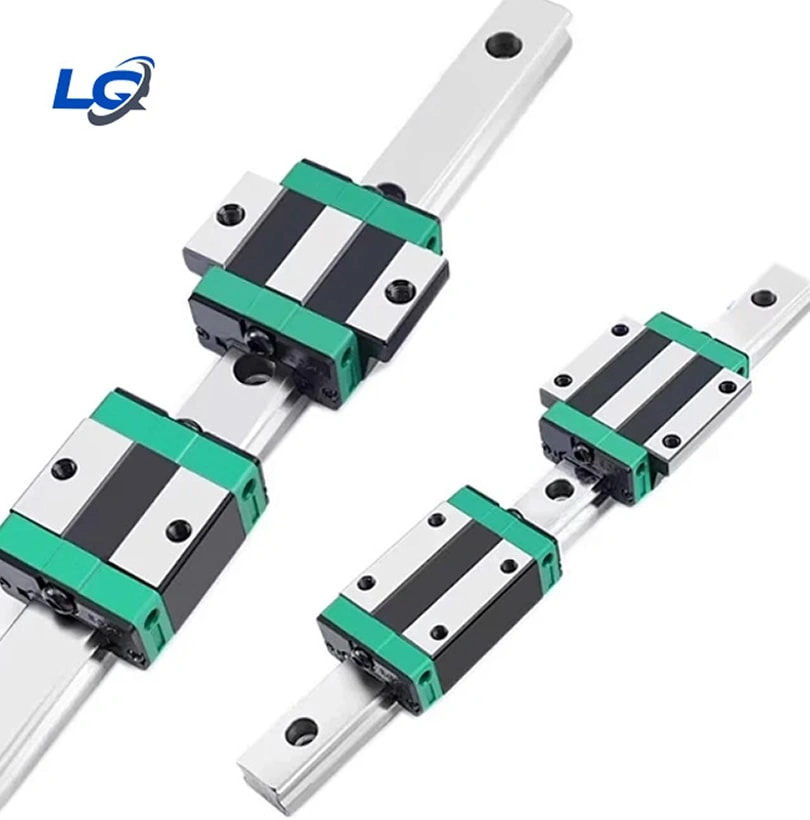
HGR linear guides use a ball-type rolling structure running on a three-side ground rail, paired with a slide block. The rolling contact keeps friction low and consistent across thousands of cycles, which is what stops positioning accuracy from drifting the way it can on a plain sliding surface as it wears in. Because HGR blocks and rails interchange within the same series, a builder can standardize block sourcing across several machine models without redesigning the mounting interface each time.
Where this shows up in practice: axes that reposition constantly — pick-and-place heads, engraving gantries, machining center tables — where cumulative wear on a sliding surface would eventually show up as lost repeatability rather than a sudden failure.
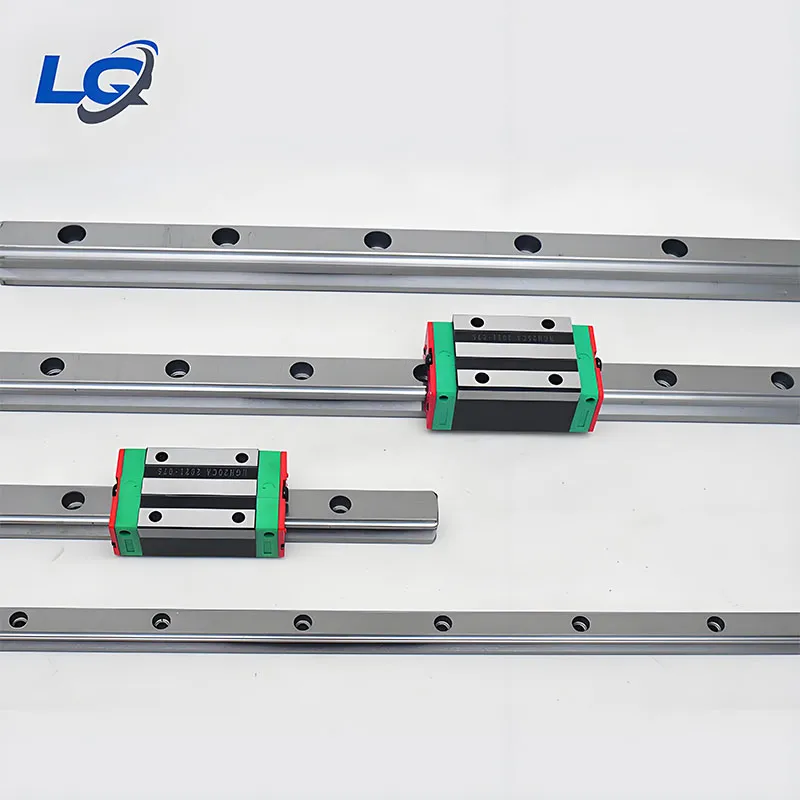
MGR guides exist because not every axis has room for a full-size HGR block. The compact, space-saving profile keeps rigidity and load capacity per unit of footprint high, which matters on equipment where the bearing housing competes for space with sensors, wiring, or a second axis mounted close by. The trade-off is capacity ceiling — MGR is chosen for precision equipment where the load is modest and the constraint is packaging, not tonnage.
EGR guides carry a self-lubricating structure that keeps friction low without a re-greasing schedule. On a shop floor running multiple machines, missed lubrication is one of the most common causes of premature rail wear, and it’s rarely caught until the axis is already noisy or stiff. EGR’s low-friction, quiet-operation design addresses two failure modes at once: reduced maintenance burden, and the noise complaints that come with a rail running dry between service intervals.
Round rail comes in two forms, and the difference between them is the failure mode each one is solving:
Both exist because an unsupported round shaft, mounted only at its ends, will sag across the middle as span length increases — supported rail solves that by carrying the shaft’s weight along its full length rather than just at the mounting points.
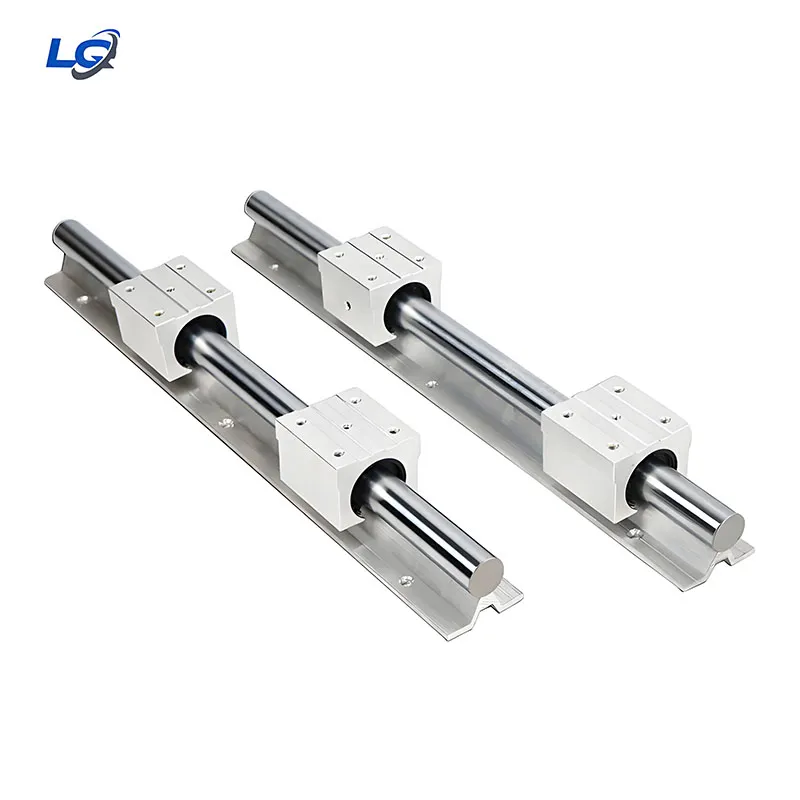
Not every axis needs profile-rail precision. LONGQIAO’s linear shaft rod is manufactured with controlled diameter and surface finish and is heat-treated for durability, then paired with a linear bearing block running as a sliding (plain-bearing) interface rather than a rolling one. This combination is the low-maintenance, budget-conscious choice for axes where load and speed are moderate and the job is simply to constrain motion to one direction — a role where a full HGR assembly would be over-specified.
⚠️ Our current product catalog does not list numeric specifications (bore size, load rating, or accuracy class) for the Linear Bearing Blocks line — see the production notes at the end of this article for what’s needed before those figures can be published.
The most frequent misstep isn’t picking the wrong rail family — it’s sizing a single block or bearing to handle straight-line load while ignoring moment load, the twisting force that shows up when the load’s center of gravity sits off the rail’s centerline (a common situation on cantilevered tooling or an overhung spindle bracket). A block rated for the vertical load alone can still wear unevenly or bind under an off-center mount, even though the datasheet load number “checks out.” This is why supported configurations like SBR and TBR specify support along the shaft rather than just at the ends — a single point of support concentrates moment load exactly where an unsupported shaft is weakest.
| Bearing Type | Rolling or Sliding | Best Suited For | Maintenance Pattern | Typical Weak Point |
| HGR profile rail | Rolling (ball-type) | Repeated-cycle precision axes | Periodic, standard interval | Higher cost than plain shaft |
| MGR miniature rail | Rolling (ball-type) | Space-constrained precision axes | Periodic, standard interval | Lower load ceiling |
| EGR self-lubricating rail | Rolling, low-friction | Axes with inconsistent maintenance access | Reduced — self-lubricating | Not sized for heavy tonnage |
| SBR support rail | Sliding on supported round shaft | Asce per grandi campate e impieghi gravosi | Standard, economical to service | Lower positioning accuracy than profile rail |
| TBR support rail | Sliding on supported round shaft | Long-span axes prioritizing accuracy | Standard | Costs more than SBR for the accuracy gain |
| Shaft rod + bearing block | Sliding (plain) | Simple, budget-sensitive axes | Depends on duty cycle and dust exposure | Not rated for high-precision repeat positioning |
Compared with generic taxonomy overviews that classify bearings by construction alone, the distinction that actually changes a buying decision is which failure mode each type is built against — construction type is the mechanism, not the reason to choose it.
According to ISO 12090, the international standard covering linear rolling bearings, classification and testing of profile-rail and ball-type linear guides follows defined accuracy and load-rating conventions — a useful reference point when comparing datasheets across suppliers, even where a supplier’s own site (like this one) doesn’t publish numeric ratings directly.
A: “Linear bearing” is the broader category — any component enabling straight-line motion under load. “Linear guide” usually refers specifically to the profile-rail, ball-type configuration (like HGR or MGR), while round-shaft and plain-bushing setups are linear bearings but not typically called guides.
A: TBR is built specifically to close that accuracy gap versus an unsupported shaft, but neither SBR nor TBR is positioned to match a ball-type profile rail’s repeat positioning accuracy — they’re chosen instead for span length and load capacity where profile rail would be over-specified or cost-prohibitive.
A: The self-lubricating structure reduces the interval, it doesn’t eliminate maintenance entirely — duty cycle, environment, and contamination exposure still affect how often service is needed.
A: Cost and simplicity on axes that don’t need rolling-element precision — the shaft-plus-block combination is the right call when moderate load and moderate speed are the whole spec, not a compromise made to save money on a job that actually needed profile rail.
If you’re scoping a new axis and aren’t sure which failure mode is the real constraint, send us your load, span, and duty cycle and we can walk through which of these four fits — not every axis needs the same answer, even on the same machine.