
A strong machine frame can still produce scrap when its moving axis shakes, binds, or wears too soon. That small guide problem grows into poor cuts, missed deadlines, and service costs. The fix starts with a linear guide selected for the real load, speed, accuracy, and working environment.
A linear guide is a mechanical system that supports a moving table, gantry, tool head, or robot and keeps it traveling in a controlled straight path. Balls or rollers move between a block and rail to reduce friction. The right design improves load capacity, positioning accuracy, rigidity, speed, and service life in CNC equipment and industrial machines.
A linear guide helps a machine part travel in one straight direction while resisting unwanted movement. The drive may be a ball screw, belt, rack and pinion, or linear motor. The guide does not create thrust. It carries the moving mass and process forces while the drive moves the axis.
A modern linear guide uses rolling elements instead of a broad sliding surface. This lowers friction, reduces stick-slip, and supports smooth linear motion.
In a machine tool, it may carry a table, spindle head, or gantry. In a robot, it may move a gripper. In both cases, its purpose is to support and guide the load without losing the intended path.
THK’s official design overview describes this technology as a set of machine elements that uses rolling contact to move an object accurately in a straight line. It also notes that mounting, load, sealing, and lubrication affect performance and life.
Most profiled systems contain four basic guide components:
Rail: The hardened track fixed to the machine base.
Block: The moving unit attached to the table or gantry.
Rolling elements: Balls or rollers that circulate inside the block.
Seals and ports: Parts that retain grease and limit dirt entry.
The carriage and the rail form one working path. Precision raceways control contact, while end caps return the rolling elements through an internal circuit.
The phrase linear guide rail often means the track alone, while linear guide system usually means the track and blocks. Buyers should confirm exactly what a quotation includes.
A round-shaft bearing is simpler and often less costly. A profiled linear motion bearing normally resists side loads and overturning moments better, which matters when a spindle sits far above the mounting surface.
A ball guide uses ball bearings between the block and track. It supports low resistance and fast travel, making it common in CNC routers, laser machines, packaging equipment, and handling units.
A roller design uses cylindrical or shaped rollers. The larger contact area can provide higher stiffness and load performance. Bosch Rexroth’s roller product information links the larger contact area of each roller to rigidity, transverse stability, and load capacity.
Roller products suit heavy loads, strong cutting forces, and tight deflection limits. They may cost more and need careful mounting. A ball-based design often balances speed, price, and precision for medium duty.
| Design Point | Ball Design | Roller-Type Linear Guides |
|---|---|---|
| Contact Element | Ball bearings | Rollers |
| Friction | Very low | Low |
| Speed | Often excellent | Good to excellent |
| Rigidity | High | Very high |
| Best Use | General CNC and handling | Heavy cutting and high load |
| Typical Cost | Lower | Higher |
The right choice depends on force, duty cycle, speed, and the allowed amount of deflection. A bigger part is not always a better part.
What Are the Different Types of Linear Guide Rail?
The phrase different types of linear guide covers several families. Each type of linear guide answers a different need.
These products use a shaped steel track and recirculating block. They offer high accuracy, good moment resistance, and multi-direction loading for CNC equipment and robots.
Supported Round-Shaft Systems
SBR and TBR use a round shaft supported by an aluminum base. An open block moves over the shaft. These guides are economical and suit woodworking equipment, light CNC machines, and moderate-precision long travel.
A hardened shaft can run with a linear ball bearing. It works well for light loads, but an unsupported shaft may bend over a long span.
A miniature linear guide saves space and moving weight in test instruments, small robots, and semiconductor manufacturing. Small raceways still need clean mounting and protection.
Special choices include wide tracks, corrosion-resistant materials, caged balls, measurement functions, and rollers for demanding machines. Bosch Rexroth’s product overview separates ball, small-format, roller, cam-roller, and shaft-based solutions because their strengths differ.
Model names narrow the search, but the drawing remains the final authority.
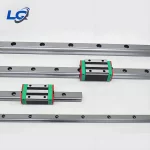
HGR linear guide products use a profiled ball structure. They offer high rigidity, good load support in several directions, and stable positioning. An HGR15 linear guide may suit a compact CNC axis, but spacing, preload, and force still need review.
SBR systems use a fully supported round shaft. They reduce shaft bending and provide a cost-effective option for long travel. An SBR16 linear rail uses a nominal 16 mm shaft, but height, block width, hole pitch, speed, and force still matter.
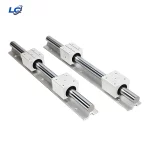
SBR Support Rail
TBR systems use a similar supported-shaft principle with another block shape and mounting pattern. A TBR16 linear rail may fit a wider table connection, but it is not an automatic SBR replacement.
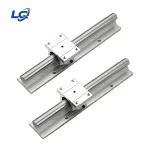
TBR Support Rail
MGR products fit small stages, electronic assembly, inspection devices, and light robots. They save space but usually carry less load than a larger profile.
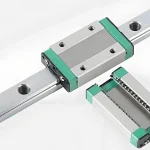
MGR Miniature Linear Guide
| Series | Structure | Main Strength | Main Limit | Typical Use |
|---|---|---|---|---|
| HGR | Profiled ball track | Accuracy and stiffness | Higher mounting demand | CNC and laser equipment |
| EGR | Low-profile ball track | Compact height | Dimensions must be checked | Small machinery |
| MGR | Compact profile | Small size | Lower load range | Electronics and robotics |
| SBR | Supported round shaft | Value and long travel | Lower moment stiffness | Woodworking CNC |
| TBR | Supported shaft, alternate block | Wide mounting form | Not directly interchangeable | General equipment |
| Shaft | Round shaft and bearing | Simple and low cost | Long-span deflection | Light mechanisms |
Our product category covers these options for machine builders and distributors that need different cost and performance levels.
Load capacity includes more than static weight. The block may receive downward, upward, and side forces, plus acceleration, shock, pitch, yaw, and roll moments. An offset spindle can create a large moment from a modest cutting force.
Track size is only one part of sizing. Block length, quantity, spacing, contact geometry, preload, and mounting direction also change the result. THK’s equivalent-load guidance explains that several load directions can act at the same time and should be converted into an equivalent design load.
High rigidity means less deflection under force. Low deflection helps limit chatter, size error, and poor surface finish. Preload can remove internal clearance and improve stiffness, but excessive preload increases resistance and heat.
High accuracy includes dimensional accuracy, running accuracy, positioning accuracy, repeatability, and parallelism between two tracks.
Even a premium guide cannot correct a weak frame, loose coupling, bent base, poor screw support, or incorrect servo tuning. Precise linear motion comes from the complete axis.
Each application creates different risks.
Linear guides are used on X, Y, and Z axes to carry tables, gantries, and spindle heads. Cutting equipment needs stiffness, while woodworking machines need dust protection.
A laser axis needs fast travel and stable repeatability. Plasma and flame machines add dust, heat, and shock. Designers may choose a profiled solution for stiffness or a supported shaft for lower cost.
Robots, transfer units, and assembly lines need short cycles and predictable movement. Low resistance reduces motor demand and a compact arrangement saves space.
These machines may need small size, controlled particles, gentle movement, and special materials. Clean conditions change the grease and sealing plan.
Packaging equipment may run millions of short cycles. Heavy tooling may justify rollers, while a ball design may suit faster and lighter work.
A useful rule is simple: match the product to the process risk. A cheap option becomes costly when it stops production.
Begin selection with the machine, not the catalog. In our work with OEM customers, we ask for the drawing and operating conditions before recommending a model. The ideal linear choice balances performance and cost across all linear systems.
THK defines nominal life as the travel distance that 90% of identical units can reach without rolling-fatigue flaking under the same conditions. Mounting, contamination, shock, and grease condition also matter.
| Machine Need | Practical Starting Point |
|---|---|
| Strong cutting force | HGR or a roller design |
| Fast general production | Profiled ball design |
| Small precision stage | MGR or another compact option |
| Long, cost-sensitive axis | SBR or TBR |
| Simple light movement | Shaft and bearing |
| Dusty work area | Sealed block plus external cover |
Selecting a linear product is an axis-design task. Check it with the ball screw or gear rack, motor torque, reducer ratio, mounting plate, and expected cycle. The guide is only one part of linear axis design, and each rail must work with the structure around it.
A good linear guide can fail early on a dirty, uneven, or misaligned base. Remove burrs, align the master track, set the second track in parallel, and tighten bolts in sequence.
Do not strike the block, force misaligned holes, or expose an open system to grinding dust. Use a transfer tool when required.
Lubrication lowers friction and wear, forms a protective film on the raceway, and helps prevent rust. THK’s environment guidance states that even sealed products gradually lose lubricant and need service at an interval suited to the working conditions.
The interval depends on travel, speed, force, vibration, temperature, grease type, mounting direction, contamination, seals, and covers.
For dust, add bellows, a shield, brush, or air purge. For coolant, check seals and drainage. For corrosion, confirm material and coating. “Maintenance-free” is not a safe universal promise.
A guide can meet its catalog rating and still perform badly in an unbalanced axis. The screw may be too small, the coupling may slip, the motor may lack speed, or the mounting plate may flex.
We are a China-based manufacturer and supplier of CNC motion and transmission parts. Our linear components and other linear motion components are designed to work as a matched axis. We supply guides, ball screws, stepper and servo systems, planetary reducers, rack and pinion products, spindle motors, and related CNC parts to OEMs and distributors worldwide.
Before supply, we review force, moment, travel, speed, accuracy, environment, matching parts, order mix, and repeat demand.
Consider a representative OEM project. A builder requests HGR15 because it fits the width. After checking spindle height, we find that wider spacing or a longer block may improve moment control more than a larger size. We then review screw lead, servo speed, supports, and coupling. The result is a better-balanced axis.
Our company profile explains this one-stop model, which can reduce vendor coordination and improve specification consistency across repeat orders.
The perfect linear guide is not the most expensive one. It is the right linear guide, installed correctly, protected properly, and matched to the full axis.
The first often means a profiled track with a recirculating block; the second often means a round-shaft bearing. A profiled design usually offers stronger moment control.
Can One Track Support a Complete Machine Axis?
Sometimes. Two tracks usually provide better table stability and moment control. A single wide track may work when loading is low.
Is a Roller Design Always More Accurate Than a Ball Design?
No. Rollers usually provide greater stiffness, but accuracy also depends on class, preload, base quality, temperature, and assembly. Linear ball guides can still provide high precision.
How Often Should I Add Grease?
There is no universal interval. Speed, travel, force, temperature, contamination, seals, and grease type all matter. Follow the product data and inspect resistance, noise, and grease condition.
No, not directly. They use different structures, dimensions, and load behavior. Any change requires a mounting and performance review.