
SBR and TBR are both supported round rails, in which a shaft is held along its length by a support rail. LONGQIAO describes SBR as the option for long-span, long-stroke, heavy-duty axes, and TBR as the one offering higher running stability and accuracy than unsupported shafts. Numeric specifications are not published online; request them with a quotation.
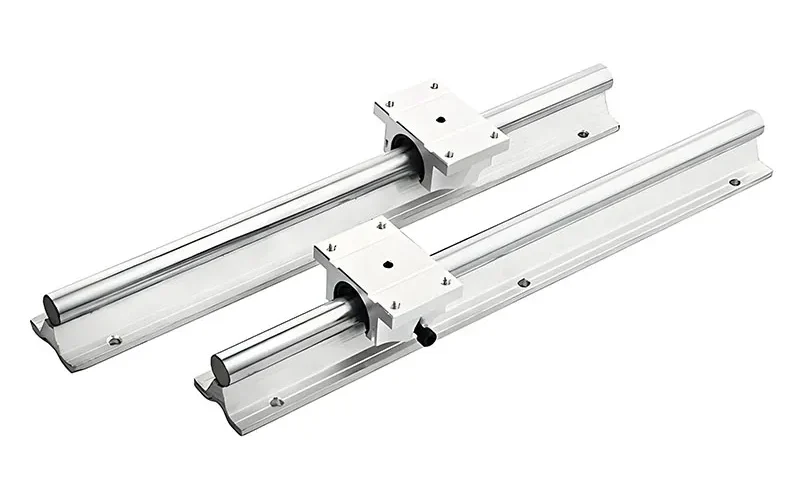
A linear shaft rod used on its own is held only where it is mounted. LONGQIAO’s Linear Shaft Rod is heat-treated, made with a controlled diameter and surface finish, and runs with sliding bearings; the catalog lists low maintenance as one of its strengths. That arrangement works until the axis gets long or heavily loaded, at which point the unsupported stretch of shaft tends to become the limiting part of the design.
A support rail addresses this by holding the shaft along its length. Compared with common unsupported shaft-and-bearing setups, that is why the catalog places supported round rails on long-span, long-stroke and heavy-duty axes. SBR and TBR are the two support rail series LONGQIAO lists for the job.

The table below uses catalog wording only. Where the catalog says nothing, the cell says so.
| Dimension | SBR Support Rail | TBR Support Rail | Linear Shaft Rod (Unsupported, for Reference) |
|---|---|---|---|
| Construction | Supported round rail and shaft | Supported guidance | Shaft used with sliding bearings |
| What the Catalog Emphasizes | Higher load capacity and rigidity for long-span, long-stroke, heavy-duty axes | Higher running stability and accuracy than unsupported shafts | Controlled diameter and surface finish; heat-treated for durability |
| Cost and Installation | Economical and easy to install | Not stated | Low maintenance |
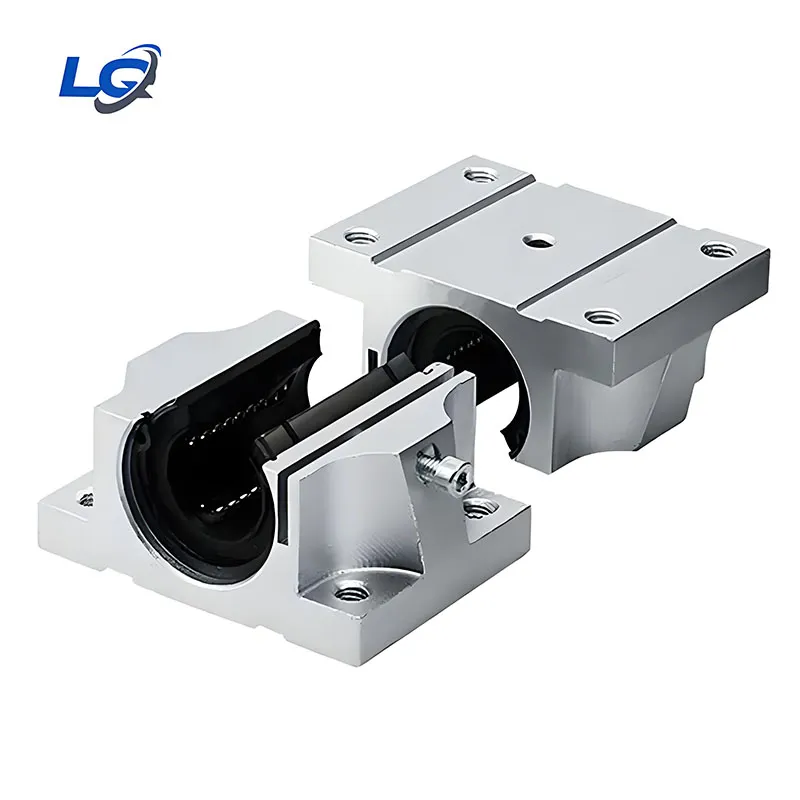
SBR‘s entry leans on load capacity, rigidity and travel length, and adds that it is economical and easy to install. TBR’s entry leans on running stability and accuracy relative to an unsupported shaft, and says nothing about cost or installation. On wording alone, a long, heavy axis points toward SBR, while an axis where positioning quality matters more than span points toward TBR.
That reading has a hard limit. The catalog gives no head-to-head numbers: it does not say how much more accurate TBR is than SBR, whether SBR is cheaper than TBR, or where SBR’s load capacity runs out. Calling either series the better one goes past what has been published.
The trade-off that actually affects a purchase is this: SBR’s economy and easy installation come with no stated accuracy claim, and TBR’s stability and accuracy claim comes with no stated cost or installation claim. A buyer with both a tight budget and a tight positioning tolerance cannot settle it from the catalog and needs the figures from LONGQIAO.
LONGQIAO (Jinan Longqiao Electromechanical Equipment Co., Ltd.) is a China-based CNC machine parts manufacturer and exporter. Since 2017 we have focused on one thing: complete motion packages — linear guides, ball screws, motors and drivers, spindle motors and matching accessories — so machine builders can source a full axis from a single supplier instead of five.
Support rails are one piece of that range, which also holds 200+ SKUs in stock. Technical support, flexible order quantities and free returns for quality issues come with orders, and pricing is quoted at competitive factory prices on request.
In LONGQIAO’s catalog, SBR is described for long-span, long-stroke, heavy-duty axes with higher load capacity and rigidity, and TBR for higher running stability and accuracy than unsupported shafts. No numeric comparison is published, so ask for both models’ dimensions and ratings.
LONGQIAO does not publish prices. The catalog calls SBR economical but does not rank it against TBR, so the reliable route is to request a quotation for both.
When the span is short and the load is modest, a Linear Shaft Rod with sliding bearings can be the simpler choice. If the axis is long-span, long-stroke or heavy-duty, the catalog points to a supported rail instead.
LONGQIAO’s current catalog lists SBR and TBR as its support rail series and does not list an RBR model. If your drawing or supplier quote carries a different code, send it with your inquiry; inquiries are answered within 24 hours.
Axis stroke, moving mass, mounting orientation, required accuracy, quantity, and the drawing if you have one. These are the values the catalog does not publish and that the model choice depends on.
No model-level certificates are published for either series. LONGQIAO’s published certificates cover the spindle motor (CE-Machinery Directive and EMC certificates of conformity) and its patent and software copyright registrations.
Send your axis stroke, moving mass, orientation and accuracy requirement, plus a drawing if one exists, and request a quotation that covers both SBR and TBR. Ask for the shaft diameter and matching carriage to be named in the reply, since those are the details this page cannot give you.