
LONGQIAO Technical Team | CNC Motion Components, Jinan Longqiao Electromechanical Equipment Co., Ltd. | Published August 20, 2026
Controller behaviour, probing cycles and input specifications vary by control system and firmware version. Confirm the input type and probe cycle against your own controller documentation before ordering hardware.
A CNC tool setter detects the moment a tool tip touches a known surface, so the control can set Z zero or store a tool length offset. Router touch plates and machining-centre setters do this differently, and the detail that decides your purchase is whether your controller accepts the signal.
A tool setter measures nothing on its own. It closes or opens an electrical circuit at a physical position, and the controller records the machine coordinate at the instant that happens. Everything useful comes from what the control does with that number.
Two jobs get confused here, and they are not the same job.
Setting workpiece Z zero. The tool descends onto a surface at a known height relative to the top of the part. The control subtracts the known thickness and writes the work offset. This is what a router owner does at the start of every job.
Storing a tool length offset. The tool descends onto a fixture at a fixed, permanent height on the machine. The control stores that tool’s length in an offset table, so any tool can be called later without re-measuring against the part. This is what a machining centre does, and it only works because the reference never moves.
A device built for one job can be pressed into the other, badly. A mobile touch plate cannot build a tool length library, because it sits somewhere different every time. A fixed table-mounted setter cannot find the top of your workpiece, because it does not know where your workpiece is.
Conductive contact. The tool and the plate form part of a circuit. A magnet or clip connects to the collet nut, spindle body or tool shank, and contact between tool tip and plate completes the loop. Simple, cheap, and dependent on both surfaces being clean and conductive.
Mechanical switching. The tool tip pushes a plunger or platform, which actuates a switch inside a sealed body. Nothing needs to conduct. A ceramic tool, a heavily coated tool or a plastic-tipped tool triggers it the same as steel.
That difference is not academic. Conductive plates fail quietly on anodised surfaces, on tools with a hard non-conductive coating, and on any tool where the clip has grabbed a painted or oxidised part of the spindle instead of bare metal. The failure mode is a tool that keeps descending, which on a router means a broken cutter and on a machining centre means something considerably more expensive.
Most pages ranking for this term treat these as one product with different price tags. They are different tools.
| Woodworking / router touch plate | Machining-centre tool setter | |
| Mounting | Loose block, placed on the workpiece each time | Bolted to the table or bed at a permanent position |
| Sensing | Conductive circuit through tool and clip | Mechanical switch, plunger or platform |
| Reference | Top of the workpiece, different every job | A fixed machine coordinate that never changes |
| Primary output | Work offset Z zero | Tool length offset in the tool table |
| Tool must conduct | Yes | No |
| Dust and chips | Sensitive. A layer of MDF dust or resin blocks contact | Tolerant. Designed to be wiped and re-used |
| Coolant | Not intended for flood coolant | Built for wet environments |
| Tool breakage check | Not practical | Common secondary use, by re-measuring a tool after a cut |
| Multi-tool workflow | Re-zero manually at each change | Automatic, from the offset table |
| Failure when dirty | Reads early, tool sits high, cuts shallow | Reads consistently or does not trigger at all |
The mismatch that costs people money runs one direction more than the other. A router owner buying a machining-centre setter has bought a good device that solves a problem they did not have. A shop buying router touch plates for a machine running flood coolant and carbide tooling has bought a device that will fail during a job.
This is the part the product listings skip, and it is the part that determines whether the hardware you order will work at all. Answer these before you pay.
Work through that list with your controller manual open. Nine questions with written answers takes twenty minutes and eliminates most of the returns we see on this product category.
A recurring assumption: inconsistent Z results mean the tool setter is not accurate enough. Usually the setter is the one part of the chain that is repeating fine.
The measurement travels through everything between the switch and the tool tip. Contributors, roughly in order of how often they turn out to be the culprit:
The practical version: if your Z repeatability is poor, probe the same spot ten times without touching anything else. If the ten readings agree, your setter is fine and the problem lives in the axis. If they scatter, look at feedrate and surface cleanliness before you look at the device.
Dust bridging on conductive plates. MDF and composite dust is not always fully insulating, and resin buildup is not always fully conductive. Either way, a plate that has been sitting in a router enclosure reads inconsistently. Wipe the plate and the tool tip before each use, not once a week.
The clip on a coated surface. The magnet has to contact bare metal. Anodised, painted or heavily oxidised spindle parts break the circuit, and the tool descends until something gives. Test the circuit by touching the tool to the plate by hand before running the cycle.
Wrong sign on plate thickness. Entering the plate thickness with the wrong sign, or entering the thickness of a different plate, puts the tool exactly twice the plate thickness away from where you intended. The first cut tells you, expensively.
Chips on a fixed setter. A machining-centre setter with a chip on the contact face measures every tool short by that amount and does it consistently, which is worse than doing it randomly, because consistency looks like correctness.
False triggers during spindle ramp. If your probe input fires when the spindle starts and never during a hand test, you have a noise problem, not a hardware fault. Go back to items 6 through 8 on the checklist.
One edge case specific to machine builders: a fixed setter mounted to a table that is itself part of a moving axis references a coordinate that moves with the axis. It works, but the offset now depends on the axis being homed identically every time. Any change in homing repeatability shows up as a tool length error across the whole tool table.
Hobby and small router, single tool per job. A conductive touch plate does the job. Buy the wiring quality rather than the device features.
Router with a tool changer or frequent manual changes. A fixed setter earns back its cost quickly, provided your controller can maintain a tool table. Check that first, because many router controls cannot.
Machining centre, flood coolant, carbide tooling. A sealed mechanical setter. Conductive plates are not a cost saving here, they are a source of scrap.
Machine you are building to sell. A mechanical setter with a normally closed output, because the end user will not diagnose noise problems and will not remember to clean a plate. Specify for the person who has never seen the machine before.
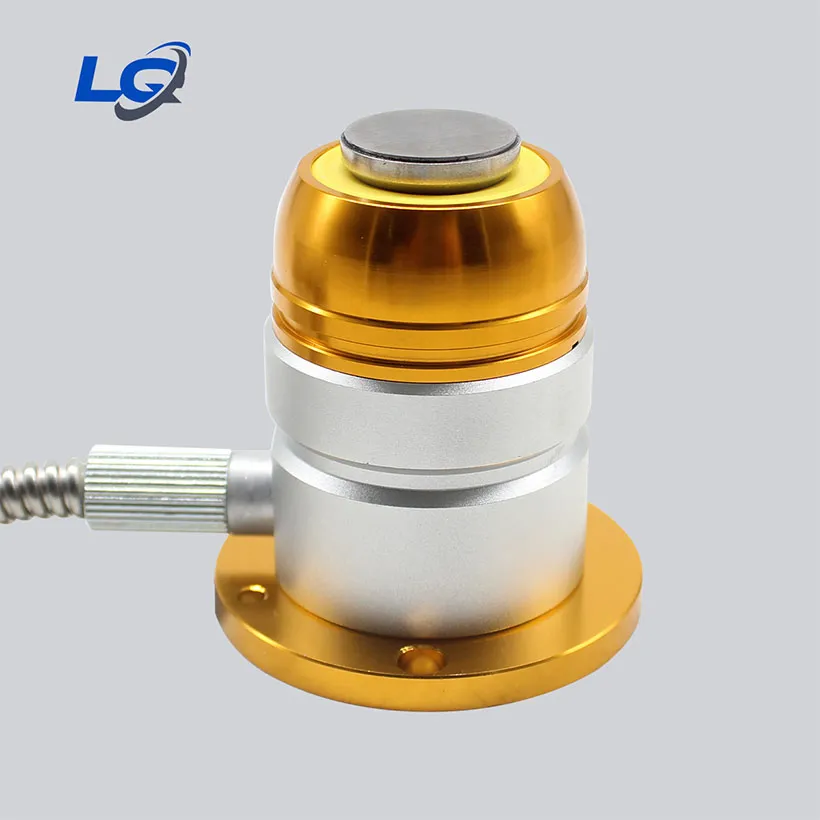
Our tool setter range covers two documented configurations: a Настройщик инструментов для деревообработки and a Machining Center Tool Setter, matching the split described above.
We do not publish repeatability figures, plunger travel, contact ratings, output type, sealing rating or trigger force for these units. That is a real limitation and worth stating plainly rather than dressing up, because items 3, 4 and 5 on the checklist above cannot be answered from a product page that does not carry them. Send your controller model and the input type it expects, and we will confirm compatibility and quote against it. Pricing is quotation-based; there is no published price list.
On certification, so there is no ambiguity: our spindle motors carry a CE Machinery Directive Certificate of Conformity and an EMC Certificate of Conformity. No certification is published at tool setter level, and we will not imply otherwise.
The reason most buyers reach us for a setter is the same reason they reach us for a lubrication unit — it arrives with the spindle, driver, rails and screws it has to work alongside, from a supplier that has been building complete axis packages since 2017. Compared with controller-specific product pages, which are precise about one control system and silent about every other, and with generic marketplace listings that give a bullet list and no compatibility guidance, the useful conversation starts from what your controller can read.
A: It gives the controller a repeatable physical reference so that touching the tool to it produces either a workpiece Z zero or a stored tool length offset. Which of those you get depends on whether the setter is mobile or fixed.
A: A touch plate is usually a conductive block placed on the workpiece to zero one tool. An automatic tool setter is normally fixed to the machine and used to build a tool length table across many tools. Different reference, different workflow.
A: Only if the controller has an input that can be read fast enough and a probing cycle to use it. Check for a dedicated probe input, the required output type, and the input voltage before ordering.
A: Normally closed is generally the safer choice, since a broken wire faults immediately instead of leaving a probe that never triggers. Confirm your controller supports that polarity.
A: No. Ceramic tools, heavily coated tools and anything that breaks the circuit will not trigger it. Those machines need a mechanical setter.
A: Probe the same spot repeatedly without changing anything. Consistent readings point to feedrate or surface contamination; scattered readings usually point to backlash, guide preload or collet runout rather than the setter.
A: A fixed setter can, by re-measuring a tool after a cut and comparing against the stored length. A mobile touch plate cannot do this in any practical way.
A: On any machine with a spindle inverter, yes, and ground the shield at the controller end only. Running an unshielded probe cable alongside the spindle motor cable is the most common cause of false triggers.
A: It depends on configuration and controller compatibility, so it is quoted rather than listed. Send your controller model and the input specification and we will price it.
Two things are worth doing the first time the device is fitted, before it goes anywhere near a production part.
Run a baseline repeatability test. Probe the same point ten times at your intended production feedrate, write the ten numbers down, and keep the sheet with the machine. That sheet is what tells you, six months later, whether the machine has drifted or whether you are imagining it. Nobody does this, and everybody who has had an argument about Z accuracy wishes they had.
Then run it again after any crash, after any collet or spindle change, and after any work on the Z axis. A tool setter is a measuring device, and a measuring device with no baseline cannot tell you when it has stopped agreeing with itself.
Worth planning for separately: if you are specifying a machine that will run unattended, decide now whether tool breakage detection is part of the cycle, because retrofitting that logic into an existing post-processor is considerably more work than including it from the start.
because retrofitting that logic into an existing post-processor is considerably more work than including it from the start.