
LONGQIAO Technical Team | CNC Motion Components, Jinan Longqiao Electromechanical Equipment Co., Ltd. | Published August 21, 2026
Lubricant selection and service intervals are specified by the manufacturer of your guides, screws and bearings. The procedure below covers method. Where it conflicts with the documentation that shipped with your components, follow the documentation.
A CNC machine needs lubricant delivered to every guide block and ball nut on a schedule. Hand pumps suit low-duty machines with an operator who remembers. Electric units suit machines that run unattended. The choice matters less than the piping and the interval behind it.
Walk the machine and write down every point that takes lubricant. On a typical three-axis build that means each guide block, each ball nut, and the fixed-end support bearings if they are not sealed for life. Sealed bearings do not want to be re-greased and will tell you so by running hot.
For each point, record the fitting thread and orientation. Guide blocks are usually supplied with a fitting on one end face and a plug on the other, which lets you feed from whichever side the machine geometry allows. Blocks that arrive plugged on both ends need one plug removed before anything will flow, and a surprising number of retrofit complaints trace back to exactly that.
Verification for this step: a written list where every line has a point, a fitting type and a feed direction. If you cannot say which side you are feeding each block from, you are not ready to route tube.
| Hand pressure oil pump | Electric lubrication unit | |
| Trigger | Operator action | Timer or machine signal |
| Suits | Short daily run times, few points, machines that are always attended | Unattended cycles, lights-out running, many points |
| Failure mode | Forgotten. Nothing warns you | Runs dry, blocks a line, or over-delivers without anyone noticing |
| Feedback | Operator feels resistance and sees the reservoir drop | Needs a level sensor or a habit of checking |
| Retrofit cost | Pump, tube, fittings | Pump, tube, fittings, power, and a control signal |
| Maintenance | Reservoir top-up, occasional seal | Reservoir, timer settings, motor, and the same tube and fittings |
The honest version of this decision is not about machine class. It is about whether the person operating the machine will actually pull the handle. A hand pump on a well-run shop floor with a shift checklist outperforms a badly set electric unit that pushes grease into a line nobody has checked in a year. An electric unit on a machine running overnight is not a preference, it is the only option that works.
Where machines get sold or moved between sites, we lean toward electric, because the operator habit does not travel with the machine.
Verification for this step: one configuration chosen, with a named reason you could defend to whoever pays for it.
Guide blocks and ball nuts are supplied with seals and internal geometry suited to one lubricant family. ISO 12090 covers linear rolling bearings and ISO 3408 covers ball screws; both product families assume a specified lubricant type rather than whatever is on the shelf.
Two rules that cause most of the damage when broken:
If a machine’s history is unknown, flush rather than guess. And label the machine with the designated lubricant, because the next person will not read this article.
Verification for this step: one lubricant designated, written on a label fixed to the pump.
This is the step people skip, and it is the step that decides whether the far axis ever sees lubricant.
Lubricant follows the path of least resistance. Tee a single line to five points of unequal tube length and the nearest point takes most of the flow while the furthest takes almost nothing. Two ways to deal with it:
Sketch the run on paper with approximate lengths before ordering fittings. Put the pump where the reservoir is visible without opening a guard, not where the bracket happened to fit.
Verification for this step: a sketch showing pump position, trunk, every branch, and where each branch terminates.
Cut tube square with a proper cutter. A tube cut with side cutters seals badly at the fitting and can shed a burr into the line.
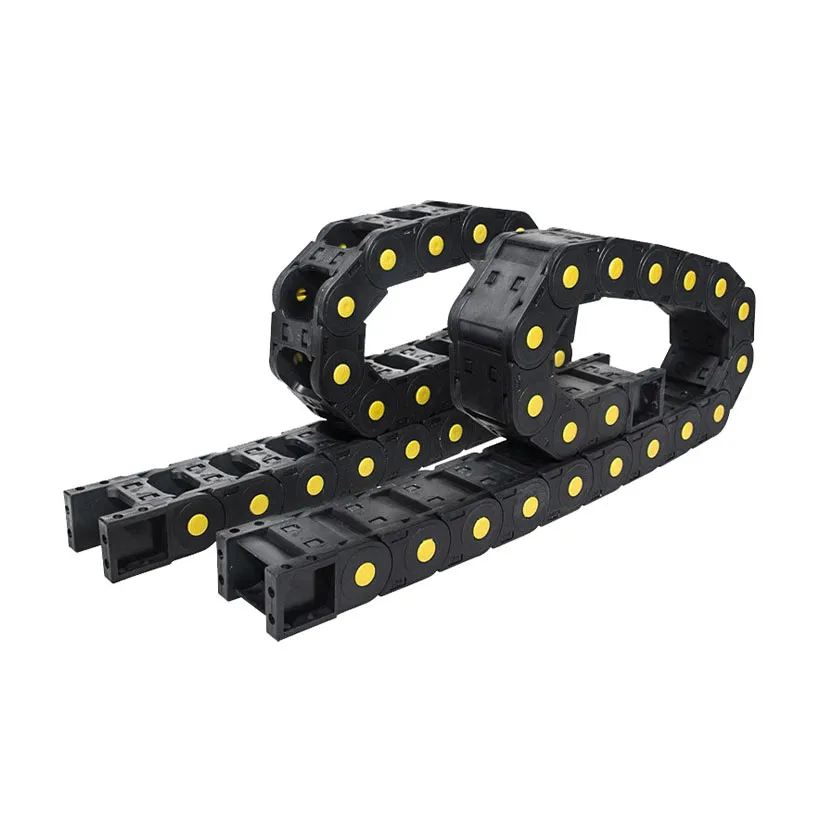
Route away from chips and coolant streams where possible. Anything crossing a moving axis goes inside a cable carrier drag chain with the same slack rules as the cables — no tension at full extension, no coiling at full retraction. Clip the tube at intervals so it cannot sag into the work envelope.
Leave a service loop at each block. A block that has to be removed for inspection should not require the tube to be cut.
Verification for this step: run each axis to both hard limits by hand or at low feed and watch the tube. No stretch, no rubbing, no pinch.
Prime the system and bleed every branch
A newly built system is full of air, and air compresses. Until the last outlet is bled, your pump is compressing air rather than delivering lubricant.
Skip this and the machine can run for weeks with an axis receiving nothing while the pump appears to be working normally.
Verification for this step: lubricant seen at every outlet, and every joint dry after a cycle.
Set the interval, then correct it from evidence
Start from whatever the component documentation specifies. If nothing is specified, base the first setting on how far the axis actually travels rather than on how long the machine is switched on. A machine idling in a warm shop consumes almost nothing; a machine running long roughing passes consumes far more in the same eight hours.
Then change one variable at a time and read the machine:
Adjust interval before you adjust volume per shot. Frequent small deliveries hold a film better than infrequent large ones.
Verification for this step: three consecutive production days where the rail film reads the same. If it drifts, something upstream is not stable.
Under-delivery is the failure most people plan for. Over-delivery is the failure most people cause.
A starved guide block runs hot, then noisy, then loses preload as the raceways wear. The accuracy loss usually shows up as a repeatability problem long before anyone connects it to lubrication. It is a slow, expensive failure, and by the time it is visible the block is finished.
Flooding is different. Excess oil washes chips into the block, carries coolant past the seals, and pushes lubricant out onto the workpiece where it interferes with finish and, in food or medical work, contaminates the part. It also masks the diagnostic signal above, since a rail can be wet with over-delivered oil while the raceway inside is running on a broken film. Flooding costs less in bearings and more in scrap.
The common misconception worth naming: that a manual pump handled twice as often is “safer than forgetting.” It is not. It is a different failure, and on a machine cutting wet, often the more expensive one.
One more edge case, since it catches machine builders specifically. Vertical axes drain. A Z-axis block on a fast-cycling machine loses film downward between deliveries in a way a horizontal axis does not, and the interval that works on X and Y can leave Z marginal. Where the axes run from one pump, either meter the vertical branch separately or set the whole system to the requirement of the axis that needs the most.
Our lubrication unit range covers two documented configurations:
Beyond those, we hold rails, ball screws, motors, drivers, spindle motors and the fittings that connect them, which is the reason most buyers come to us for a lubrication unit in the first place: it arrives matched to the guide blocks and ball nut it has to feed, rather than as a separate sourcing problem. Since 2017 that one-stop axis matching has been the point of the business.
We do not publish flow rates, outlet counts, operating pressure, voltage or timer ranges for these units, and we would rather say that than print figures we cannot stand behind. Tell us the axis lengths, the number of lubrication points and whether the machine runs unattended, and we will send the unit specification and a quotation. Pricing is quotation-based; there is no published price list.
This is a deliberate difference from what page one of a search for this term offers. Marketplace listings give a spec bullet block with no method for deciding whether those specs suit your machine, and the selection guides that do rank tend to mark their own figures as illustrative. Neither tells you how many points you have or how far your Z-axis drains. That part has to come from your machine.

A: If the machine is attended for its whole run time and the operator has a checklist, a hand pump works. If it runs unattended for any part of a shift, use an electric unit. The deciding factor is supervision, not machine size.
A: Usually yes, provided both accept the same lubricant and each branch is metered or resistance-balanced. Where the screw and the guides specify different lubricants, they need separate systems.
A: Follow what the block manufacturer specifies. Oil generally suits higher speeds and systems with distribution metering; grease suits lower-duty machines and longer intervals. What you must not do is switch between them without flushing.
A: Start from the component documentation, base it on axis travel rather than machine on-time, and correct it by checking the film on the rail after a production day. A thin film that shows on a cloth is the target.
A: No. It means the pump is not being triggered, a line is blocked, or the system was never bled. A working system consumes lubricant at a rate you can measure over a week.
A: Either that branch is longer than the others on a shared unmetered line, or it is a vertical axis draining between deliveries. Meter the branch separately, or set the system to the neediest axis.
A: Yes, and it is common. The work is in mapping the points, removing the plugs on blocks that have never been fed, and finding a trigger signal if you are fitting an electric unit.
A: Blocks are typically supplied with a fitting and a plug so you can feed from either end. Confirm the thread when you order so the tube fittings match on arrival.
A: It depends on configuration, reservoir size and how many outlets you need, so it is quoted rather than listed. Send the point count and whether the machine runs unattended and we will price it.
Once the system has been running for a few weeks, pull the machine out of production for twenty minutes and do the following. Remove one guide block end plug and look at what comes out — fresh lubricant means the line is live, dark or gritty means chips have found their way in and the seals or the flooding rate need attention. Then check the tube where it enters the drag chain, which is where abrasion shows first. Finally, re-read the reservoir level against your own log rather than against memory.
Also worth planning for: lubricant viscosity behaves differently in an unheated winter workshop than it does in August, and a system tuned in one season can under-deliver in the other. If your shop swings seasonally, note the interval you set and the ambient temperature you set it at, so the next adjustment starts from data instead of from scratch.