
A bomba de óleo acionada manualmente lubricates CNC machine ways by manually forcing oil through a fitting into the way surface, and doing it right depends on priming the pump correctly, using a full steady stroke, and following a consistent interval — not just topping up whenever the ways look dry.
Most search results for “hand pump oil” point toward automotive fluid transfer and drum-mounted pumps, which is a different tool and a different technique from a small hand pressure pump feeding CNC way lubrication points. This guide covers the machine-tool use case specifically.
A hand pressure oil pump built for machine ways is sized to deliver a controlled, metered charge of oil at enough pressure to reach the lubrication point through the fitting — it’s a different tool from a drum-transfer pump built to move volume quickly. Check that the pump’s output fitting matches your machine’s grease or oil nipple type before assuming it will connect.
A new pump, or one that’s sat empty, has air in the line. Pump the handle several times with the outlet open before connecting to the machine — you’ll feel the resistance change and see oil (not just air) reach the outlet once it’s primed. Skipping this step means the first several strokes on the machine push air into the line instead of oil, and it looks like the pump delivered lubricant when it didn’t.
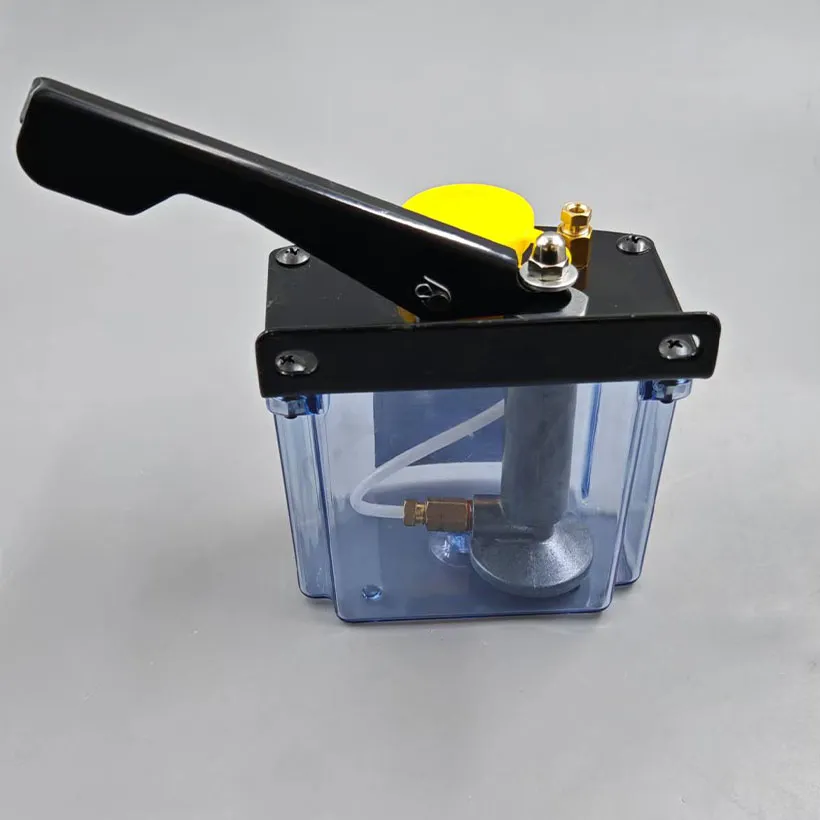
Machine ways typically have dedicated lubrication fittings separate from other grease points on the machine — spindle bearings, fuso de esferas supports, and way surfaces are usually not the same fitting. Confirm you’re feeding the way lubrication point specifically; pumping oil into the wrong fitting wastes the stroke and leaves the ways under-lubricated even though maintenance was “performed.”
A full stroke pushes a consistent, known volume of oil per pump. Short, partial strokes push an inconsistent volume and are also more likely to draw air back into the line on the return stroke, which then has to be primed out again on the next use. Pump at a steady rate rather than rapid short strokes — steady pressure moves oil into the way surface more evenly than a fast jab.
How often the ways need lubrication depends on how many hours the axis actually runs and how it’s loaded, not a fixed weekly or monthly schedule applied to every machine the same way. A machine running near-continuous multi-shift production needs oil more often than one that runs a few hours a day — track actual run hours where possible, and adjust the interval instead of defaulting to “whatever the last technician did.”
After pumping, run the axis through its full travel and check that the way surface shows an even oil film across its length, not just near the lubrication point. A dry spot partway down the travel usually means the interval is too long for that axis’s duty cycle, or the fitting isn’t distributing oil the way the way design intends.

Seeing oil appear at the pump outlet only confirms the pump primed correctly — it doesn’t confirm the oil reached and spread across the way surface. Technicians who stop at “I saw oil come out” often miss dry spots further down long travels, especially on axes where the lubrication point is at one end. Run the axis and visually check the way surface after pumping, not just the pump.
| Dimension | Hand pressure oil pump | Automatic/central lubrication system |
| Lubrication timing | Manual — depends on technician following the interval | Programmed — delivers on a fixed cycle regardless of who’s on shift |
| Upfront cost | Lower — simple mechanical pump | Higher — pump unit, distribution lines, controller |
| Consistency risk | Depends on operator discipline and logging | Removes the human-error step from timing |
| O mais adequado | Lower-duty machines, smaller shops, single or few axes | Multi-shift or high-duty-cycle machines where missed intervals are costly |
| Maintenance | Simple — check reservoir level, prime as needed | More components to maintain (lines, distribution valves) |
Compared to an automatic central lubrication system, a hand pump shifts the entire lubrication-timing responsibility onto whoever’s on shift that day — that’s a reasonable trade on a lower-duty machine, but it’s worth naming explicitly rather than assuming a hand pump and an automatic system deliver equivalent protection just because both put oil on the ways.
Consistent way lubrication is one of the more commonly cited factors in linear guide and rail service life in motion-control maintenance coverage, including trade publications like Linear Motion Tips — a missed or inconsistent lubrication interval shows up as premature wear well before it shows up as a visible problem.
A: If the handle feels loose or spongy compared to normal, or oil stops appearing at the outlet after a few strokes, air has likely gotten back into the line — prime it again with the outlet open before connecting to the machine.
A: Only if the pump and fitting type match what each point requires — way lubrication and bearing grease points are often different systems with different fittings, so check before assuming one pump covers both.
A: It depends on the axis length and the pump’s delivery volume per stroke, not a universal number — track what your specific machine needs by checking for an even oil film across the full travel, and adjust from there.
A: Over-lubrication mainly wastes oil and can attract more debris to the way surface, but it’s a far smaller risk than under-lubrication, which leads to dry running and accelerated wear — when in doubt on a new machine, err toward a shorter interval and adjust down once you’ve confirmed coverage.
A: Yes, but oil delivered manually on a vertical axis tends to migrate downward faster than on a horizontal way, so vertical axes often need more frequent, smaller applications rather than the same interval used on a horizontal axis.
A: When missed or inconsistent intervals are causing measurable wear issues, or when the number of lubrication points and shifts makes manual tracking unreliable — at that point the upfront cost of an automatic system usually pays for itself in avoided guide and rail replacement.