
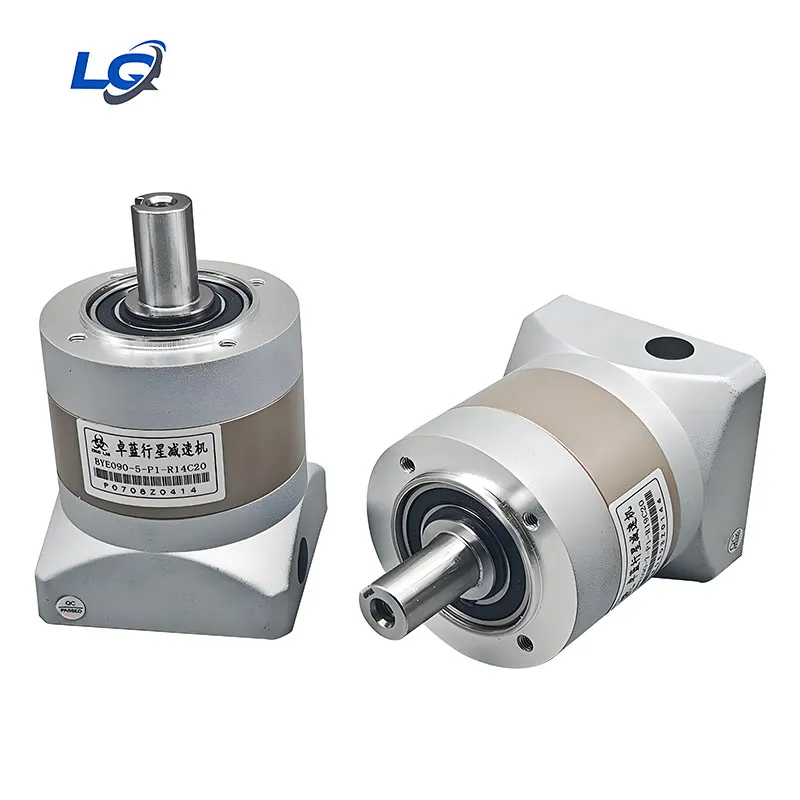
A redutor de engrenagens planetárias multiplies torque and cuts output speed by running a sun gear, several orbiting planet gears, and a fixed ring gear inside one compact housing. Machine builders add one between the motor and the driven axis whenever the motor alone can’t deliver enough torque at the speed and resolution the axis actually needs.
Inside the housing, a small sun gear driven by the motor shaft meshes with two or more planet gears mounted on a carrier. Those planets roll around the inside of a fixed ring gear, and the carrier — not the ring — becomes the output shaft. Because several planet gears share the load simultaneously instead of one pair of gears carrying it alone, the same reduction ratio comes out of a noticeably smaller housing than a single-stage spur gearbox would need. That’s the main reason planetary units show up on machine axes where panel space is tight but torque requirements aren’t.
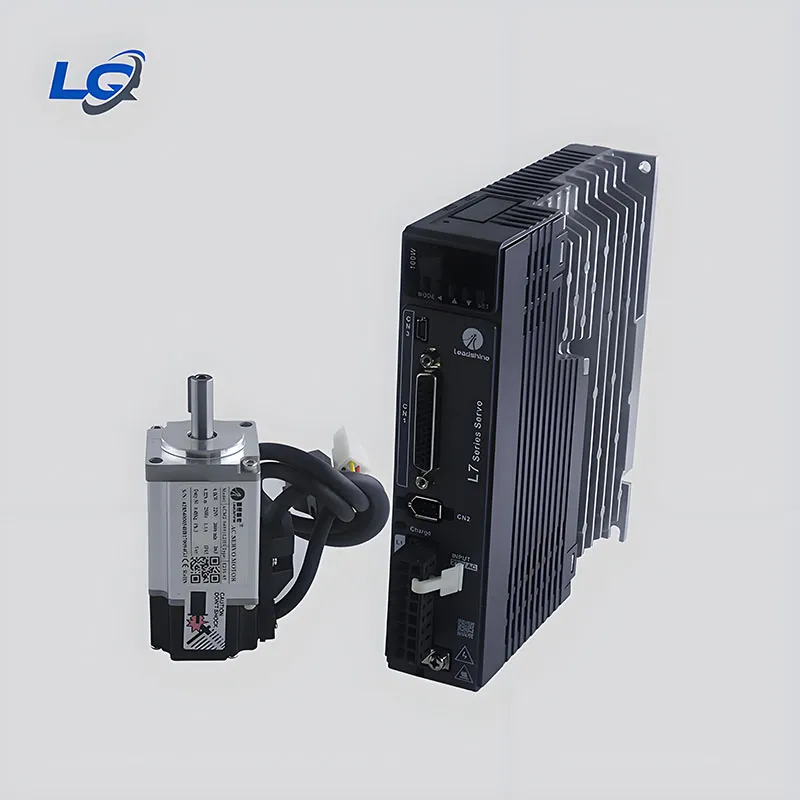
A servo or stepper motor produces a fixed torque-speed curve. Two situations push a builder toward adding a reducer rather than sizing a bigger motor:
The trade-off is backlash. Every gear mesh introduces some rotational play, and planetary units are no exception — precision-grade planetary reducers control this tightly, standard-grade units less so. On axes where positioning accuracy repeats in one direction only (most point-to-point motion), backlash matters less. On axes that reverse direction under load — probing moves, bidirectional cutting passes — backlash shows up directly as lost motion at every reversal.
The ratio isn’t chosen in isolation — it follows from what’s downstream of the reducer. The same motor paired with the same reducer family produces a different practical ratio choice depending on whether it’s driving a rack and pinion, a ball screw, or a belt.
Rack and Pinion Axes
Rack and pinion translates rotary motion to linear motion directly at the pinion’s pitch diameter, so the reducer’s output ratio sets both the linear speed and the resolution per motor step or encoder count. A lower ratio (closer to direct drive) gives higher travel speed but coarser resolution per input pulse; a higher ratio gives finer resolution but caps top speed. Long-travel axes — gantry routers, large-format cutting — often favor a ratio biased toward speed, since the rack’s own mechanical resolution is usually the tighter constraint anyway.
Ball Screw Axes
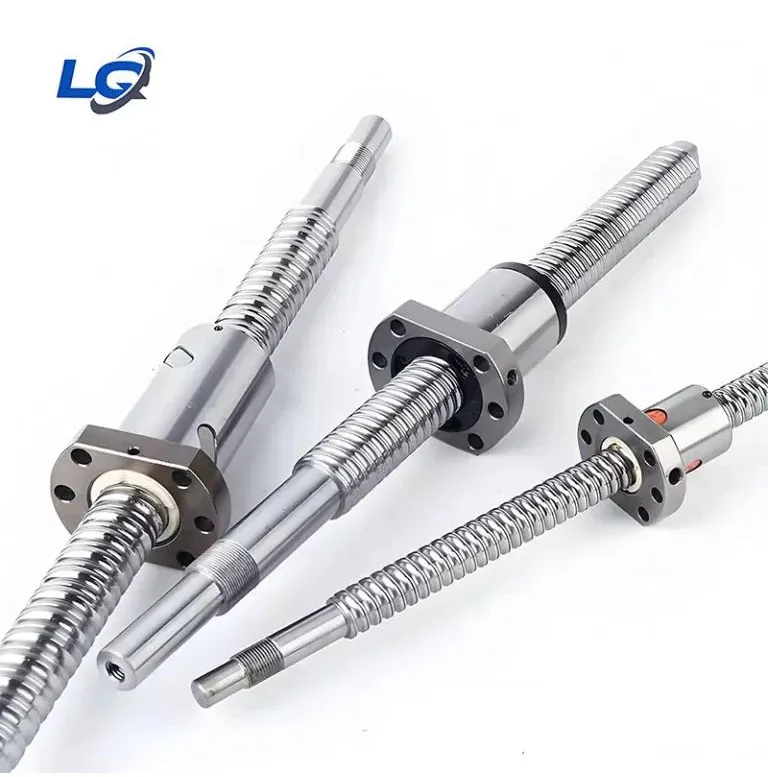
A fuso de esferas already reduces rotary motion to linear motion through its lead, so the reducer and the screw lead work together, not separately. Pick the reducer ratio first to get the motor into an efficient torque-speed range for the expected axial load, then let the screw lead — not the reducer — set final linear resolution. Stacking a high reducer ratio on top of a fine screw lead usually oversolves resolution at the cost of top speed the axis doesn’t need.
Belt-Driven Axes
Belt-driven axes typically need less torque multiplication than screw or rack axes carrying the same load, since the pulley radius already provides some mechanical advantage. Here the reducer’s main job is usually inertia matching for tuning stability rather than raw torque — a moderate ratio that brings reflected inertia into a workable range for the motor and drive, without over-reducing speed the belt axis was designed to use.
Common Mistake: Picking the Ratio From a Torque Chart Alone
A frequent selection error is reading required torque off a load calculation, matching it to a reducer’s rated output torque, and stopping there — without checking what ratio that torque rating corresponds to and whether that ratio still delivers the speed and resolution the axis needs. Two reducers can hit the same torque number at very different ratios, and only one of them leaves the axis able to run at its designed speed. Size ratio and torque together, not torque first and ratio as an afterthought.
| Dimension | Planetary reducer | Worm gear reducer | Direct drive (no reducer) |
| Torque density for size | High — compact housing for the torque delivered | Moderate — bulkier for equivalent torque | N/A — motor torque only |
| Backlash | Low to moderate, precision-grade units control it tightly | Very low, self-locking under load | None (no gear mesh) |
| Eficiência | High, typically over multiple stages still efficient | Lower — sliding contact generates more heat loss | Highest (no mechanical loss) |
| O mais adequado | Axes needing torque multiplication plus inertia matching | Axes needing self-locking (vertical holds without brake) | Low-inertia, direct-response axes with adequate motor torque |
| Maintenance | Sealed, low maintenance in most designs | Higher wear on the worm over time | None, but motor must be oversized to compensate |
Compared to sizing a larger frame motor to skip the reducer entirely, a planetary stage usually costs less in panel space and total system weight for the same torque output — the trade a builder is making is added backlash, not added complexity, since a sealed planetary unit needs little ongoing maintenance.
Motion control trade coverage in publications such as Machine Design has long treated inertia matching, not just torque, as the primary reason designers add a reduction stage between motor and load — worth checking directly if inertia ratio calculations are new to your team.
A: It depends entirely on the motor’s torque-speed curve and the load’s torque and inertia requirements — there’s no single normal ratio. Work backward from the axis’s required output torque and speed rather than picking a ratio first.
A: No. It reduces backlash relative to some other gear types and standard-grade planetary units still have measurable play; precision-grade units minimize it further but don’t eliminate it. If the axis reverses under load, backlash is a selection factor, not a solved problem.
A: The reducer itself can, but the ratio you’d choose usually differs, because the screw lead already provides linear reduction that the rack and pinion doesn’t. Size the ratio to the specific axis, not to the reducer family in general.
A: When the axis needs to hold position under load without back-driving — a vertical axis without a separate brake, for example — a worm gear’s self-locking behavior does something a planetary reducer doesn’t do on its own.
A: The output shaft turns slower relative to the motor, but linear axis speed depends on what’s downstream — rack pitch, screw lead, or pulley radius — so a higher ratio doesn’t automatically mean a slower linear axis if the downstream mechanism is sized accordingly.
A: A higher ratio reduces the load’s inertia as reflected back to the motor by roughly the square of the ratio, which generally makes servo tuning more stable — this is often the deciding factor even when torque alone wouldn’t require a reducer.