
Việc lựa chọn động cơ servo không phù hợp có thể dẫn đến mô-men xoắn yếu, độ chính xác định vị kém, quá nhiệt, rung động hoặc hệ thống truyền động có kích thước quá lớn và tốn kém. Đối với các nhà chế tạo máy CNC và kỹ sư tự động hóa, giải pháp không chỉ đơn thuần là chọn công suất cao hơn. Bạn cần phải đảm bảo sự tương thích giữa động cơ, bộ điều khiển servo, tải, tốc độ, quán tính, hệ thống phản hồi và điều kiện làm việc của máy.
To choose the right AC servo motor, calculate the required load torque, peak torque, speed, motor inertia, acceleration, duty cycle, and positioning accuracy. Then match the servo motor with a compatible servo drive, encoder, brake, cables, power supply, and mechanical transmission. The best servo motor is the smallest properly sized motor that can safely meet both continuous and peak operating requirements.
For CNC machine OEMs and automation equipment manufacturers, servo motor selection affects much more than axis movement. It affects machining accuracy, cycle time, stability, machine cost, and after-sales reliability.
At LONGQIAO / LQ, we supply servo motors and servo drivers together with other CNC transmission and motion control components. Based on the requirements we commonly see from machine builders, buyers should treat the motor and drive as one system rather than selecting each component separately.
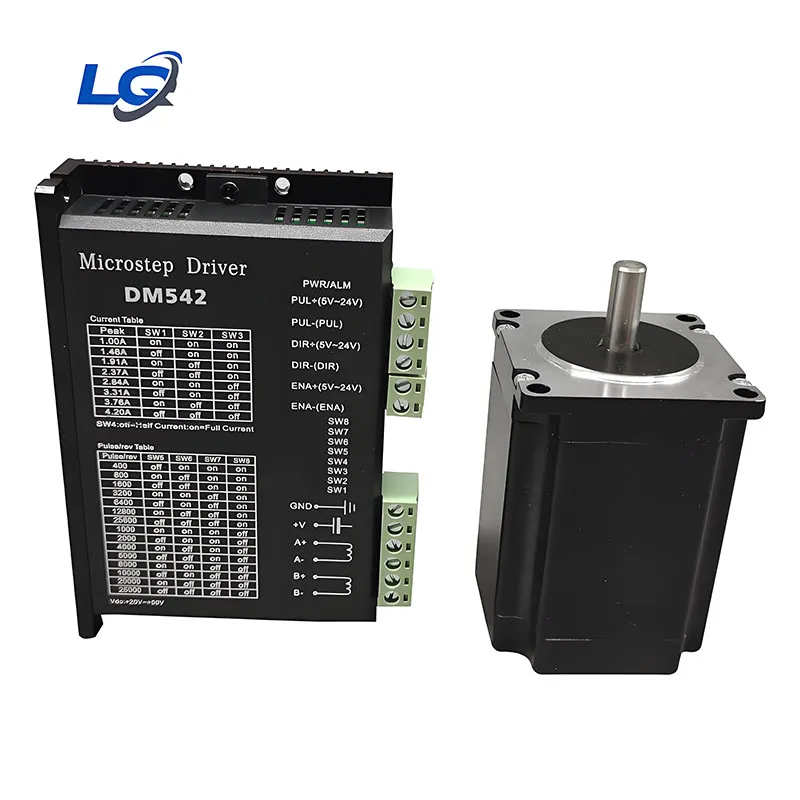
Before going deeper, this table gives you a practical motor selection checklist.
| Selection Factor | What You Need to Check | Why It Matters |
| Load | Moving mass and external force | Determines required torque |
| Tốc độ | Required axis or rotary speed | Determines motor RPM |
| Acceleration | How quickly the machine must move | Affects peak torque |
| Motor inertia | Load-to-motor inertia relationship | Affects response and stability |
| Duty cycle | Continuous or intermittent operation | Affects thermal sizing |
| Accuracy | Required positioning and repeatability | Influences encoder and control choice |
| Công suất | W or kW requirement | Helps narrow motor size |
| Điện áp | AC 220 V, 380 V, etc. | Must match the system |
| Brake | Vertical axis or holding requirement | Prevents unwanted movement |
| Servo drive | Motor-compatible driver | Controls current, speed, torque, and position |
| Environment | Dust, temperature, vibration | Influences reliability |
| Mechanical system | Ball screw, rack, gearbox, coupling | Changes torque and speed requirements |
A common mistake is starting with wattage. Power matters, but servo motor sizing should start with the machine load and required motion profile.
An AC servo motor is an electric motor designed for accurate control of position, speed, and torque. Unlike a basic motor that simply rotates when power is applied, a servo motor works as part of a closed-loop servo system.
The basic control path looks like this:
Controller command → Servo drive → Servo motor → Machine movement → Encoder feedback → Servo drive correction
The servo drive receives a command from the controller and supplies the correct electrical current to drive the motor. An encoder monitors the actual movement. The system continuously compares commanded movement with actual movement and makes corrections.
This is why servo motors rely on feedback. The feedback loop lets the system maintain accurate movement even when the load changes.
In a CNC machine, for example, the servo motor and drive system may rotate a ball screw. The ball screw converts rotary motion into controlled axis movement, while the linear guide supports the moving structure.
That combination creates a complete precision axis:
Servo motor → Coupling/gearbox → Ball screw → Linear guide → Machine table
For a deeper look at the transmission side, see LONGQIAO’s CNC linear motion component guide.
There are several types of servo motors, and they do not all fit the same machine.
The AC servo motor is one of the most common choices in modern industrial automation, CNC machinery, robotics, packaging equipment, and production lines.
Typical benefits include:
Modern AC servo systems are often brushless, which helps reduce mechanical wear and maintenance.
A DC servo motor uses DC electrical power and closed-loop feedback. Traditional DC servo systems were widely used in earlier automation and control equipment.
Some systems use a brushless DC servo, combining electronic commutation with feedback control. A brushless DC motor can provide good efficiency and controllability, although industrial CNC equipment now commonly uses AC servo solutions.
A rotary servo motor produces rotational movement at the motor shaft. This is the standard structure used in many CNC axes.
It can drive:
A linear servo motor produces direct linear movement rather than first creating rotary movement.
A linear servo can be useful in equipment requiring very high acceleration, fast response, and precision because it can remove some intermediate mechanical transmission components. However, system cost, thermal management, installation, feedback, and control requirements can be more demanding.
An integrated servo combines several control or drive elements into a compact package. It can reduce wiring and installation space in suitable automation equipment.
There is no universal winner among different servo motors. The appropriate servo motor depends on the application.
Many buyers begin with a question such as:
“Should I use a 400 W, 750 W, 1 kW, or 1.5 kW servo motor?”
That is useful, but it should not be the first question.
A servo motor is defined by its closed-loop control and feedback architecture rather than by a specific wattage. LONGQIAO’s servo information notes that industrial servo systems can cover a broad range of power ratings, with smaller ratings serving compact mechanisms and larger motors supporting heavier machinery.
A simplified power relationship is:
Power (W) = Torque (N·m) × Angular Speed (rad/s)
For rotary speed in RPM:
P ≈ T × RPM × 2π / 60
Suppose your machine needs about 2 N·m at 3,000 rpm:
P ≈ 2 × 3000 × 2π / 60 ≈ 628 W
That does not automatically mean a 630 W motor is correct. The motor must also survive acceleration, peak loading, thermal conditions, duty cycle, and mechanical losses.
The motor must meet both continuous and short-term peak requirements.
Torque is one of the most important variables when you select a servo motor.
You normally need to consider at least three torque conditions:
For rotational systems, a simplified relationship is:
T = J × α
Where:
T = torque
J = total inertia
α = angular acceleration
The real calculation may also include friction, gravity, cutting forces, transmission efficiency, and external loads.
This is especially important for CNC equipment. A motor can produce enough torque at low speed but still fail to meet acceleration or high-speed requirements.
Do not size only around nominal running conditions. If rapid acceleration is part of the machine cycle, the peak requirement can determine which servo motor you need.
Motor inertia describes how strongly a rotating body resists changes in speed. It matters because a servo system constantly accelerates and decelerates the mechanical load.
A badly matched load can create:
The exact acceptable load-to-motor inertia ratio depends on the motor, drive, control tuning, mechanical stiffness, and application. Do not use one universal ratio for every system.
When selecting servo motors, include the inertia of:
For a linear axis, the moving mass must also be converted into equivalent rotational inertia at the motor shaft.
This is why choosing a motor only from machine weight is risky.
Two machines can move the same 100 kg load but need completely different motors.
Tại sao?
One may accelerate slowly and travel at moderate speed. The other may need rapid start-stop cycles every few seconds.
A complete motion profile should include:
| Tham số | Example Question |
| Travel | How far must the axis move? |
| Maximum speed | What is the required rapid speed? |
| Acceleration time | How quickly must it reach that speed? |
| Deceleration | How quickly must it stop? |
| Dwell time | How long does it remain stationary? |
| Cycle frequency | How many cycles per minute? |
| Duty cycle | How long does the motor operate continuously? |
The servo motor’s characteristics must match this profile.
For high-cycle equipment, the average thermal load also matters. A motor that handles one fast movement may not handle that same movement hundreds of times per hour.
That distinction is critical in packaging machinery, pick-and-place systems, automatic assembly lines, and other servo motor applications.
LONGQIAO supplies motion components for automation and assembly line systems where repeatability and continuous operation are key purchasing requirements.
A servo motor and drive should be treated as a matched pair.
The servo driver converts control commands into the electrical output required to drive the motor. At the same time, it processes encoder feedback and regulates motor operation.
When matching a servo motor driver, check:
Do not assume that two components with the same power rating will automatically work together.
For example, a 750 W motor from one series may use a different encoder, connector, current requirement, or control protocol from another 750 W system.
The safest approach is to match the complete servo motor system according to manufacturer specifications.
LONGQIAO’s Servo Motor & Servo Driver range includes solutions for CNC and automation applications with different performance requirements.
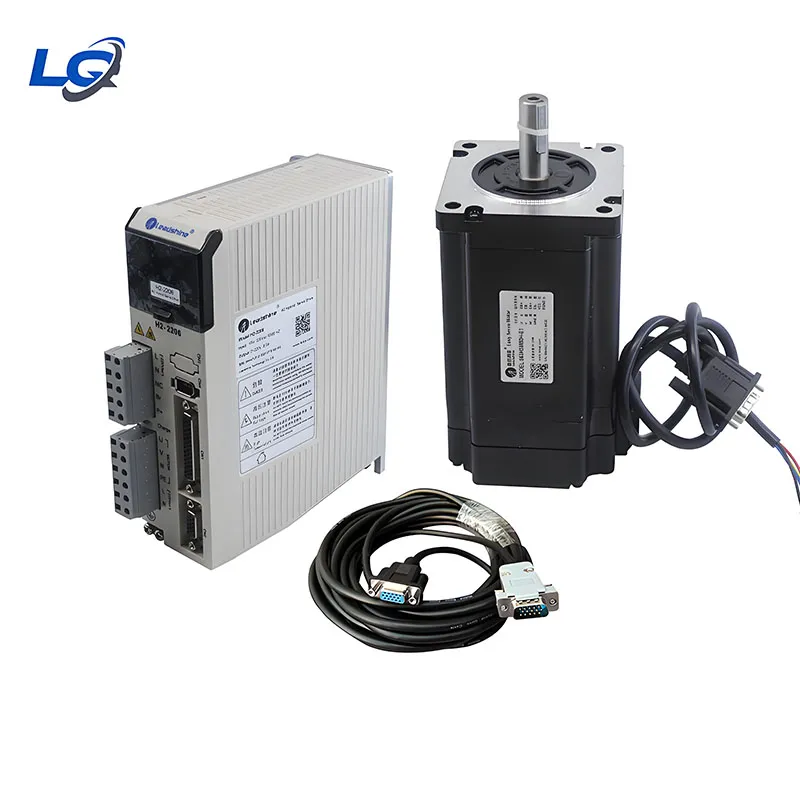
The power supply must match the servo drive rather than simply matching the number printed on the motor.
Depending on the system, an AC servo may use:
Always confirm the specific drive specification.
Also consider:
Poor electrical design can make a good servo motor perform badly.
In multi-axis machines, the electrical system must also account for several axes accelerating or decelerating at the same time.
The servo motor vs stepper question is common in CNC and automation.
A traditional stepper motor system moves through discrete commanded steps. It can be simple and cost-effective for moderate-speed applications.
A servo motor uses feedback and continuously corrects position, speed, or torque.
Stepper Motor Comparison
| Factor | AC Servo Motor | Stepper Motor |
| Feedback | Closed-loop | Often open-loop |
| High-speed torque | Stronger | Usually drops faster |
| Position correction | Yes | Limited in open-loop systems |
| Dynamic response | Cao | Trung bình |
| System cost | Cao hơn | Thấp hơn |
| Control complexity | Cao hơn | Simpler |
| High-speed CNC | Strong choice | Application dependent |
| Light automation | Good | Often very economical |
A stepper motor system can still be the right choice for budget-sensitive machines, 3D printers, simple positioning equipment, and moderate-speed applications.
There is also a middle option: the stepper servo motor or hybrid closed-loop stepper system.
For example, LONGQIAO’s H2-758 hybrid servo drive combines stepper architecture with closed-loop feedback to help prevent step loss and improve positioning stability.
So when comparing a stepper servo, standard stepper, and AC servo, focus on actual machine requirements instead of assuming that the most expensive option is always best.
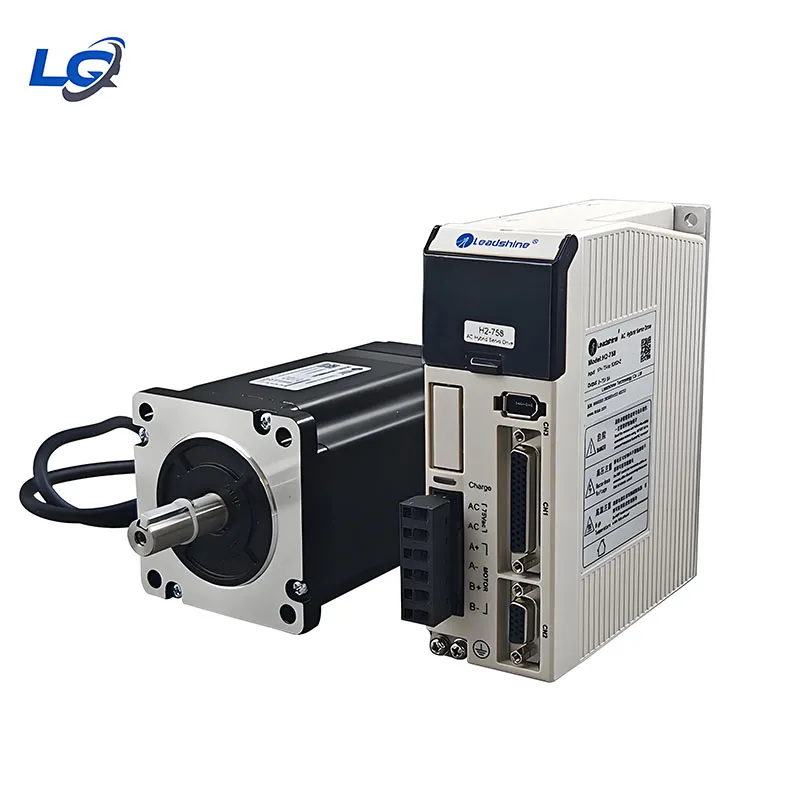
The motor itself is only one part of a complete servo system.
Common servo motor accessories include:
A servo motor brake is particularly important for vertical axes.
When power is removed, gravity can move the load downward. A holding brake helps prevent unwanted movement.
Common examples include:
A brake should not automatically be treated as the normal dynamic stopping device. Its role depends on the motor and system design.
Correct servo motor cables matter because motor power and encoder signals have different electrical requirements.
Poor cable routing can cause:
Follow the supplier’s wiring and shielding requirements when you install a servo motor.
Servo motor wiring usually involves more than connecting three motor phases.
Depending on the model, connections can include:
The wiring of the servo motor should always follow the motor and servo drive documentation.
Do not swap phases, encoder wiring, or connectors based on assumptions from another motor series.
For machine OEMs, standardized cable sets can reduce assembly errors and simplify after-sales replacement.
A servo motor does not work alone. The mechanical transmission can change the motor’s required speed, torque, and inertia.
This combination is common in CNC axes.
The motor rotates the ball screw, and the nut moves the axis.
Key variables include:
A smaller screw lead generally requires more motor revolutions for the same travel distance but can provide greater mechanical advantage.
A planetary gearbox can reduce speed while multiplying output torque.
This can help:
Rack and pinion systems are common on longer CNC axes where high travel speed is required.
LONGQIAO’s technical guidance on rack and pinion CNC drives explains why axis travel and transmission design influence the choice between rack drives and rotating ball screws.
The important point is simple: match the motor to the whole mechanical system, not just the load.
Different equipment creates different motion demands.
| Đơn đăng ký | Typical Priority | Servo Selection Focus |
| CNC router | Smooth axis movement | Speed, torque, encoder accuracy |
| Laser cutter | Fast positioning | Acceleration, response |
| Plasma machine | Long-axis movement | Speed, durability |
| Machining center | Độ chính xác cao | Rigidity, feedback, torque |
| Automated line | Repeatability | Duty cycle, reliability |
| Pick-and-place | Fast cycles | Low inertia, acceleration |
| Rotary table | Torque and position | Gearbox matching |
| Vertical axis | Holding safety | Brake, torque |
Servo motors are widely used in applications that need fast, repeatable, controlled movement.
For CNC machining centers, the motor must work with the complete axis structure. LONGQIAO’s CNC machining center component solution combines motors, drivers, ball screws, linear guides, spindle motors, and related parts for complete machine-axis sourcing.
A good servo motor selection guide should also explain what not to do.
Two 750 W motors can have different:
Power alone is not enough.
A larger motor may look safer, but excessive sizing can increase:
A cost-effective servo motor is not simply the cheapest unit. It is a correctly sized motor that delivers the required performance without unnecessary capacity.
Buying the motor first and checking the drive later creates compatibility risk.
Treat the motor or drive question as a system-matching problem.
Continuous torque is only part of the calculation. Acceleration and sudden load changes may require much more torque for a short period.
The ball screw lead, gearbox ratio, pulley diameter, or pinion size directly changes the required motor performance.
For OEM production, ask whether the same motor, drive, cable, and connector series can remain available over the product life cycle.
This matters greatly for distributors and machine manufacturers maintaining installed equipment.
If you want a supplier to help match the motor, sending complete information can make selection much faster.
Prepare the following:
For replacement projects, send the old motor and drive nameplate information as well.
Photos of connectors, shaft dimensions, flange dimensions, and existing wiring can also reduce matching errors.
For an OEM, distributor, or automation integrator, selecting the right component is only half the purchasing problem. You also need supply stability.
LONGQIAO / LQ focuses on one-stop CNC parts supply from China, including servo and stepper systems, linear guides, ball screws, spindle motors, planetary reducers, rack and pinion components, and related motion parts. Its current site also highlights stocked common models, component matching, selection assistance, and support for machine development and retrofit requirements.
This creates several practical benefits for B2B buyers:
Instead of buying a motor from one supplier, a ball screw from another, and a linear guide from a third, machine builders can consolidate more of the motion system through one sourcing partner.
That can reduce purchasing work and make technical coordination easier.
Different machine builders may require different options for servo motor configurations. A standard catalog model is not always enough.
Depending on project requirements, procurement discussions may cover:
For distributors and machine brands, servo motor customization should also be evaluated from a commercial perspective. Packaging, repeat orders, model consistency, replacement availability, and shipment consolidation can be just as important as the motor specification itself.
LONGQIAO’s broader product portfolio lets buyers discuss a servo motor for industrial machinery together with the other components needed to build the axis.
This is especially useful for:
To choose the right servo motor, calculate the application’s required speed, continuous torque, peak torque, acceleration, load inertia, duty cycle, and positioning accuracy. Then select a compatible motor, servo drive, encoder, brake, cables, and power supply. Finally, verify the motor against the actual mechanical transmission.
Start with the load and motion profile. Calculate running torque, acceleration torque, maximum speed, and reflected inertia. Then compare these values with the motor’s continuous torque, peak torque, speed range, and inertia. Servo motor sizing should also include a suitable safety margin without excessive oversizing.
An AC servo normally uses closed-loop encoder feedback and offers strong high-speed performance, dynamic response, and position correction. A standard stepper is often simpler and cheaper but may lose torque at high speed. Closed-loop stepper systems provide another option between traditional stepper and servo architectures.
A brake is commonly recommended for vertical axes or applications where the load could move when power is removed. Whether you need one depends on the machine’s mechanical structure and safety requirements.
Usually not. The servo drive must support the motor’s voltage, current, power, encoder, feedback protocol, and control requirements. Using a manufacturer-recommended motor-drive combination reduces compatibility risk.
Send your machine type, load, required speed, acceleration, transmission structure, positioning requirement, voltage, brake requirement, controller information, installation dimensions, and required quantity. For replacement motors, send the original nameplate and dimensional information.
Choosing an AC servo motor is not just about selecting a motor from a catalog. For an OEM or automation integrator, the real goal is to build a stable, compatible, and repeatable motion system that can move from prototype testing to mass production without creating new purchasing or after-sales problems.
LONGQIAO supports global CNC machine manufacturers, distributors, trading companies, and automation integrators with servo motors and drivers plus matched CNC motion components. Buyers can combine servo systems with ball screws, linear guides, planetary gearboxes, rack and pinion systems, spindle motors, and related parts instead of managing each component through a separate supplier.
For a faster quotation and technical recommendation, send us your machine type, motor power or current model, required torque and speed, voltage, brake requirement, transmission method, mounting dimensions, controller interface, cable length, and order quantity.
Whether you need a standard servo set for a CNC router, a matched drive solution for an automation line, replacement parts for installed equipment, or multi-component sourcing for production, LONGQIAO can help you identify a practical configuration and streamline procurement.
Contact LONGQIAO with your application parameters to discuss servo motor selection, compatible servo drives, matched transmission components, pricing, availability, and bulk supply.